
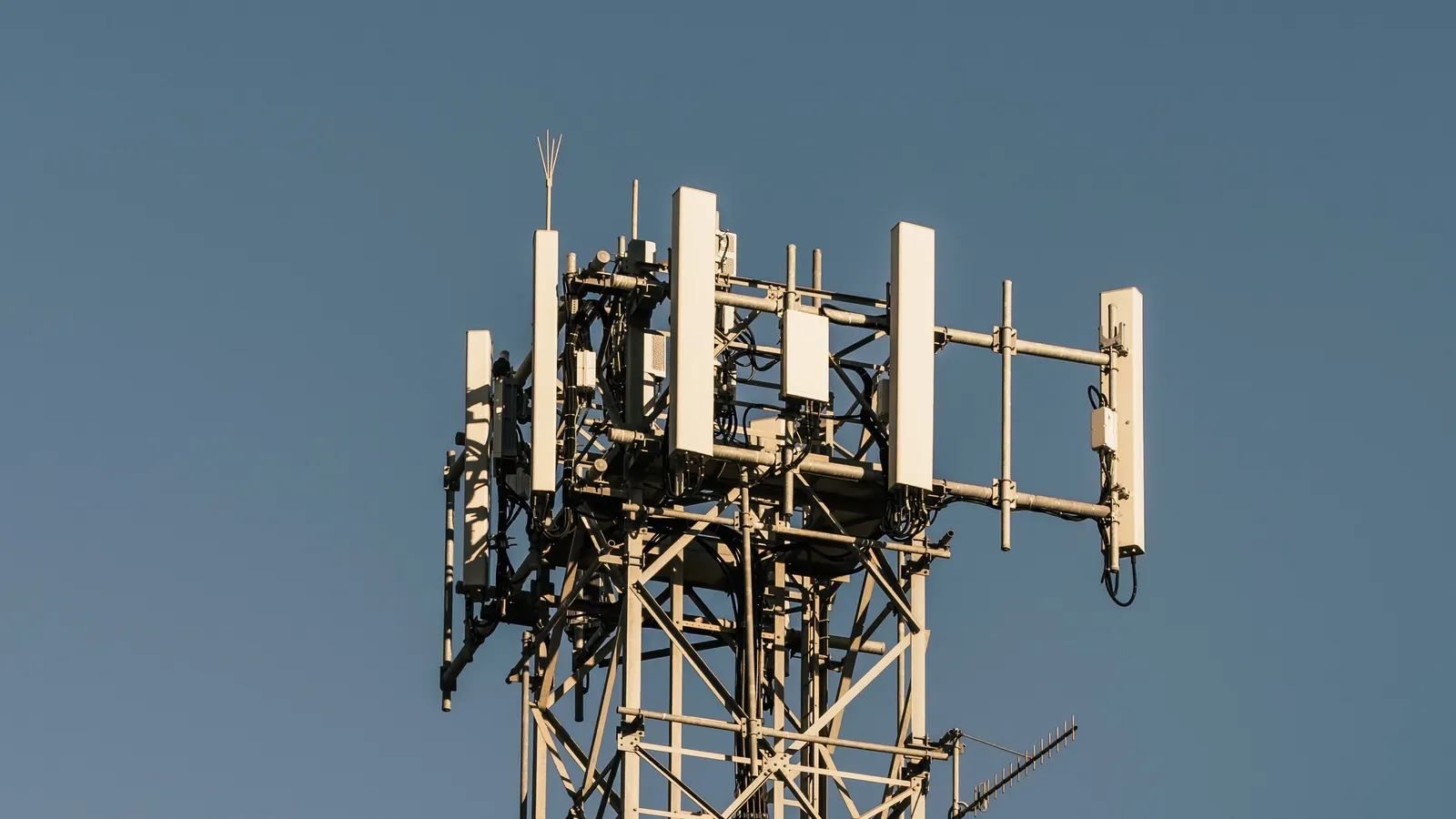
A telecommunications operator can put a photograph a customer or a building desk can match on a technician badge, on a contractor card, and on a site pass, when it keeps those three files apart. Name the file before the truck rolls, capture the face before the hard hat goes on, and store an end date on every card you print. A driver's license, a Form I-9 portrait, and a passport stay on the path that owns them.
Employees follow the employee badge page and the HR badge guide. Agency crews follow the staffing guide and still need your contractor card. A fiber build follows the construction guide, a power company on the same pole follows the utilities guide, and a cage in someone else's hall follows the data center guide. Guards follow the security guide. A route truck follows the fleet guide for the yard. A work visa follows the immigration guide.
What does one shared photograph cost a telecommunications operator?
The cost shows up at a front door and at a central-office desk. The customer is home for a window that has already started, and the only picture on file is a cab selfie with sunglasses still on. Last month's contractor card still opens the equipment room. A battery delivery printed on the technician template looks like someone who installs service.
The U.S. Bureau of Labor Statistics counted about 257,800 telecommunications technician jobs in 2025. The page splits that into equipment work other than lines (143,100), line work (103,400), and radio, cellular, and tower work (11,300). Employment is projected to decline 3 percent from 2025 to 2035. About 20,300 openings a year are still projected, on average, because people leave. A once-a-year photo day misses those hires, and it misses a Saturday trouble call.
On that page, the largest employers are telecommunications (61 percent), specialty trade contractors (13 percent), and heavy and civil engineering construction (7 percent). The contractor still employs the person, so the card you print ends with your work order. Technicians travel to homes, businesses, central offices, and outdoor sites, and they wear hard hats on ladders and elevated equipment. Many work nights or weekends, and some are on call, so a headquarters camera is closed when the truck is at the curb. A separate BLS series counted 559.1 thousand employees in the telecommunications subsector (NAICS 517) in October 2026, seasonally adjusted and preliminary. That figure is every job in the subsector, and it leaves out technicians on contractor payrolls outside it.
| File | Who it is for | When it ends | What goes wrong when the files are mixed |
|---|---|---|---|
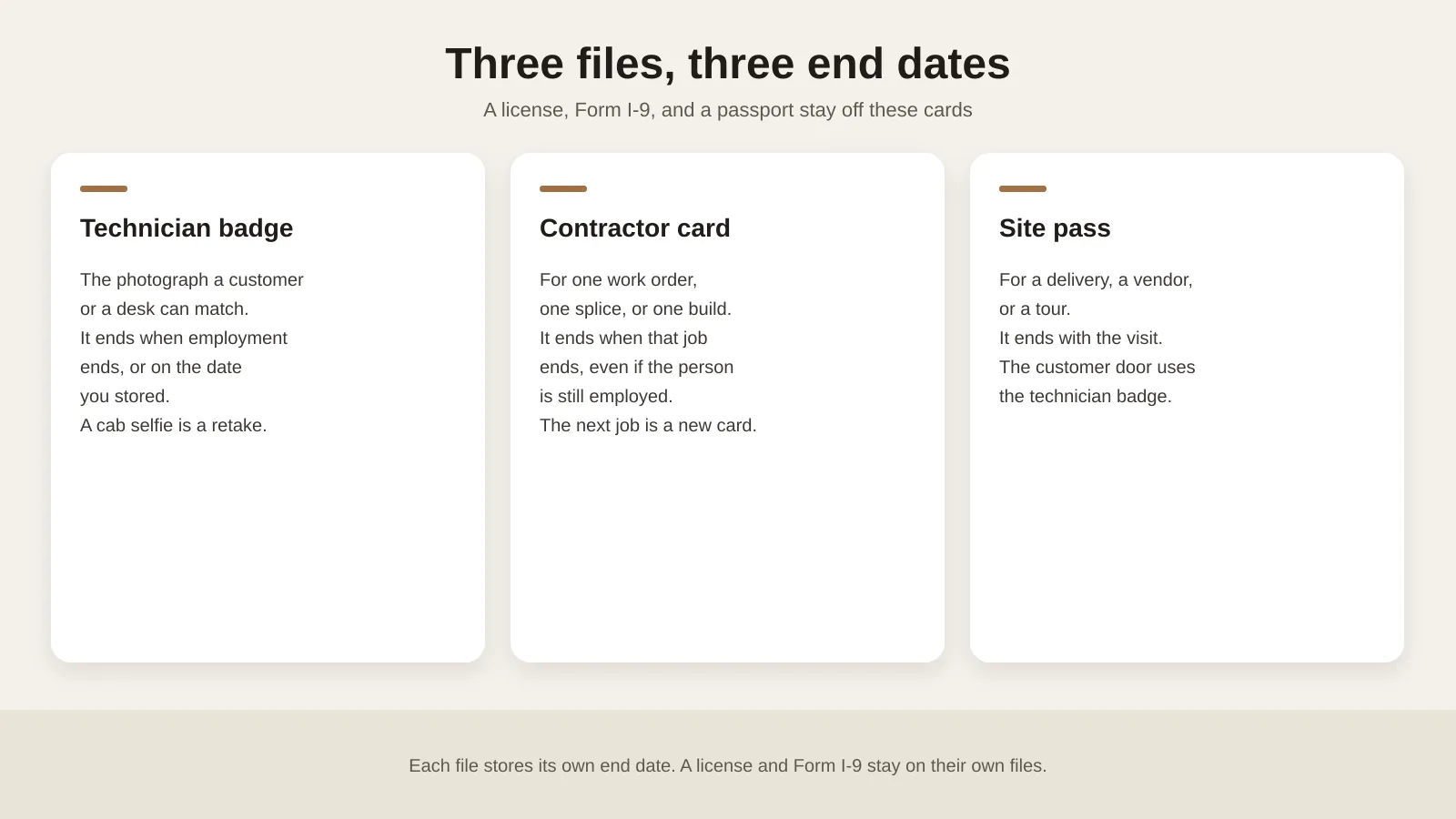
| Technician badge | An employee of the operator. One file can print the customer card and the central-office card. | Employment ends, or the date you stored. | A cab selfie, or a badge left live after the person leaves. |
| Contractor card | One work order, one splice, or one build. | The last day of that job. | Last month's card still opens the equipment room. |
| Site pass | A delivery, a vendor, or a tour. | The visit. | A visitor who looks like a technician. |
| Driver's license or CDL | Travel to a job site. BLS notes a driver's license, and a commercial license for heavy vehicles. | The date the state prints. | Copying the license photo onto the badge. |
| Form I-9 | People the operator employs in the United States. The employee chooses the documents. A badge is off the Lists of Acceptable Documents. | The Handbook's clock. | Filing the badge as proof of identity. |
| Passport or visa | The issuer's own capture. A U.S. visa follows the Department of State. A UK passport photograph meets GOV.UK photo rules. | The issuer's date. HM Passport Office still decides. | Sending the badge crop to the embassy. |
The Handbook for Employers requires Form I-9 when the operator hires someone in the United States. Section 2 is due within three business days, or on the first day when the job lasts fewer than three. A right-to-work check happens before UK employment. The contractor's employer holds the contractor's form. On an E-Verify case, compare the photo E-Verify displays with the document the employee chose.
Which file owns this photograph?
The operator sets the crop and decides which door the card opens. One employee file can feed a customer-facing card and a central-office card, and both end with employment. The contractor card ends with the work order. A vendor at the dock gets a site pass. Form I-9 and the license stay back. When a contractor returns, deactivate the old card and open a new one.
A travel document, and a remote start. Capture the badge portrait again. A UK passport photograph meets GOV.UK photo rules, and a UK passport photo code retrieves it. HM Passport Office still decides. A U.S. visa photograph follows the Department of State and stays unedited. Print and mailing, available per request, covers a card needed before a remote start.
Which door is this card for?
| Door | Card | What that door needs to see |
|---|---|---|
| A customer's home or business | Technician badge, company and name readable. | A current face, eyes visible. The appointment script names that card. |
| A central office or a headend | Technician badge, or the contractor card for that work order. BLS describes both buildings. | A face that matches a card still inside its end date. |
| A tower compound or a delivery | Contractor card for that work order, or a site pass for one visit. | An end date at the gate. Electric-utility crews follow that utility's card. |
How do operators collect these photos today?
One inbox holds the night-before replies: a cab selfie, a group picture at the tower base, and a passport scan meant for a visa. Someone crops them after the roster goes out. The Saturday trouble call leaves while the photo desk is closed, and the new hire, the contractor, and the vendor leave with cards that look alike.
What does a split workflow look like?
On Monday 23 November 2026 one market starts a fiber build through 11 December 2026. A company technician keeps the employee badge, and that portrait prints both the customer card and the central-office card. A splicing contractor whose work order ended Friday 20 November 2026 gets a new contractor card, and the old card is deactivated. A tower crew stays through 25 November. A battery delivery and a headend tour that Monday each get a site pass.
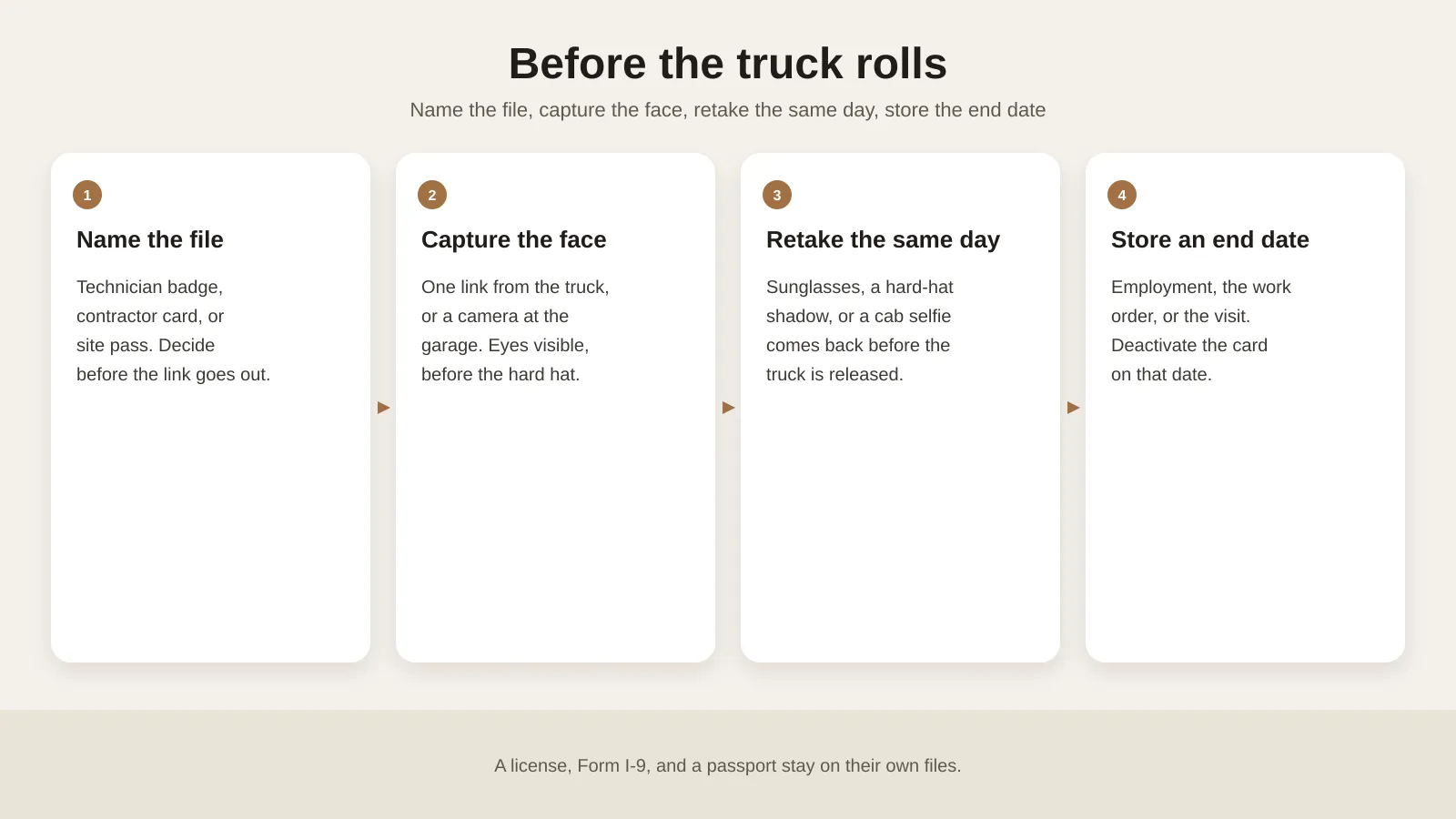
1. Write down who holds the camera. One person, eyes visible, on the link or at the garage, before the hard hat and the sunglasses go on. A cab selfie is a retake. A generated headshot stays on the careers page.
2. Sort people by the record that already owns them. The technician badge follows employment. The contractor card ends on the last day of that work order. The site pass ends with the visit. The next work order is a new card.
3. Collect the file on one link, or at the garage. The badge photo service emails one link per person, expired after use, available per request from support@idphoto.ai. It leaves the license, Form I-9, and the passport alone. Someone who starts before the photo desk opens uses that link from the truck. Keep a camera at the garage for anyone who did not.
4. Reject a bad capture the same day. A photo compliance check can return a pass or a fail before you print. Background removal and photo enhancement apply only when the template allows them. A passport or a visa stays unedited. A face-mask check is available per request, and a hood across the face is a retake. Send the common mistakes guide back while the person is still on the link.
5. Write the file back with its date. Face comparison checks a replacement. Liveness detection is available per request on a phone capture from the truck. Take the copy back, or use a temporary link of 2 hours to 14 days, and deactivate the card on its date.
6. Batch one crew on one template. Batch preparation returns a retake list before the trucks are released. Print the three cards in three colors so a site pass is obvious at a desk. The customer door uses the technician badge.
What should an operator require from a photo service?
| What you need | What good looks like |
|---|---|
| A specification per card | Size, crop, and background per window. See the spec code reference. A license, a passport, and Form I-9 sit outside it. The catalog covers 300+ specifications across 200+ countries. |
| Rejection before the truck rolls | Face, light, blur, and framing the same day, including a Saturday call. Leave a passport unedited. |
| A path off the headquarters camera | One link per person, expired after use, plus a camera at the garage. |
| The record that owns the person | The file returns with its end date. Workday or SAP SuccessFactors sync is available per request for employees already in those systems. The contractor card and the site pass stay off that sync. |
| A check a desk can explain | Face comparison and liveness detection, available per request. The operator still decides who may enter a building and who may stand at a customer's door. |
How do you roll this out in one market first?
Write the file rule before the first link. Name the three templates, the end dates, and which doors each card opens. Name who completes Form I-9 for the operator's own hires, who runs a UK right-to-work check, and who checks a license when the job needs one. Write down the color of each card and give that note to the desk and to the team that talks to customers.
Run one market for one build. Use 23 November 2026 through 11 December 2026. Include a contractor who sends the portrait from home, a short first job, a customer install, and one battery delivery, so Form I-9 and all three cards are tested before the trucks leave. Ask the desk to turn away one expired card.
Add the next market after a write has held. Prove a clean upload, a same-day retake, and one failed write that is retried. Then open the second market on the same templates. Connect Workday or SAP SuccessFactors for employees only after support confirms it. Contractors and visitors stay off that sync. Delete each card copy on its date.
Where do technician photos usually fail?
| What fails | What to change |
|---|---|
| Last work order's card still opens the equipment room | Deactivate it on the last day. The next job is a new file, in a different color. |
| A contractor is added as staff so the photo will sync | Keep the contractor card. Sync is for employees already in Workday or SAP SuccessFactors. |
| A site pass looks like a technician badge | Use a color a desk can tell apart. The customer door uses the technician badge. |
| The badge is offered as Form I-9, a right-to-work check, or a license | Those records stay on the files that own them. The card is for the customer and the desk. |
| The only portrait is a hard-hat selfie, a cab selfie, or a copy of a license | Capture again with the eyes visible, before the truck is released. The license stays in the wallet. |
Who may see a technician photograph?
The person, the people team, the desk that matches a face, and the customer at the door may see the file that role needs. A contractor's employer may see the contractor-card portrait when the contract says so. Delete the operator's copy on the card's date. GDPR Article 5(1)(e) and the CCPA apply where those laws apply. The data privacy policy covers encrypted transmission, a temporary link of 2 hours to 14 days, or taking the image back. US and EU processing are available. Other regions are available per request.
What do field operations leads ask?
Can a hard-hat photo or a copy of a driver's license go on the badge?
Capture a plain portrait, eyes visible, before the hard hat goes on. The license photograph stays on the license the state issued.
Can a contractor card use the employee template?
Store the work order's last day on the contractor card. The next work order is a new card. The technician badge stays for the operator's own people.
Can someone send a photo before the truck rolls?
Yes. One link, expired after use, available per request from support@idphoto.ai. Keep a camera at the garage.
Does the badge replace Form I-9, a right-to-work check, or a license?
A badge is off the Lists of Acceptable Documents. A UK check happens before you employ someone. The license stays in the wallet.
When should the photograph be deleted?
Delete the operator's copy on the card's date. A new work order is a new file. A license follows the date the state prints. Form I-9 follows the Handbook's clock.
What does preparing the photograph cost?
See pricing. The catalog covers 300+ specifications across 200+ countries. A license fee is paid to the state that issues the license.
How does idphoto.ai fit this workflow?
The idphoto.ai API is the photo step. It prepares a portrait to the template you name, checks the capture, and returns a file for the employment record, the contractor record, the site-pass record, or the printer. The operator decides who receives a card and which door it opens. A UK passport photo code retrieves a photograph that meets GOV.UK photo rules. HM Passport Office still decides.
Templates, the self-service link, Workday or SAP SuccessFactors sync, print and mailing, liveness detection, a face-mask check, another processing region, and the Shopify store template with one-click setup are each available per request. The store template sells photos at a counter and stays off the technician record. Email support@idphoto.ai with the card designs, which doors each pass opens, and how the file returns. Samples stay in the API docs.
Where do these facts come from?
- BLS Occupational Outlook Handbook, Telecommunications Technicians.
- BLS Industries at a Glance, Telecommunications (NAICS 517), October 2026 employment, seasonally adjusted and preliminary.
- Handbook for Employers, section 2.0, the Lists of Acceptable Documents, retention, and the Justice Department's Form I-9 page.
- E-Verify photo matching.
- GOV.UK, checking a job applicant's right to work, GOV.UK photo rules, and the Department of State photo page.
- GDPR Article 5(1)(e) and the California Consumer Privacy Act, where those laws apply.