

A film or television production can put a photograph that base camp can match on a crew badge, on a day-player card, and on a vendor or visitor pass, when it keeps those three files apart. Name the file before anyone uploads, capture the face before call time, and store an end date on every card the production prints. A child performance licence, a passport or visa, and a Form I-9 portrait stay on the path that owns them.
Studio payroll follows the employee badge page and the HR badge guide. Background performers from a casting company follow the staffing guide and still need your day-player card. Set construction follows the construction guide, lot security follows the security guide, a stadium shoot still needs that venue's pass, and an airport ramp follows the airport guide. Travel documents follow the immigration guide. Starting from $0.20 per photo.
What does one shared photograph cost a production?
The cost shows up at call time. A production assistant holds the line because the day player's only picture is a selfie taken in a car. A card from last week's booking still opens the stage. A marketing headshot, lit from the side, does not match the person at base camp, and the unit waits on a reprint.
The U.S. Bureau of Labor Statistics counted about 181,000 producer and director jobs in 2025, about 19 percent of them in motion picture and video, with assignments from one day to a few months and about 12,100 openings a year. That count leaves out electricians, day-player makeup artists, and catering crews, who still need this production's pass.
| File | Who holds the camera | What goes wrong when the files are mixed |
|---|---|---|
| Crew badge | A link before the first call, or the camera at base camp. | A marketing headshot, a costume, or a card with no wrap date. |
| Day-player card | That call's template, or the booking dates on the deal. | Last week's card still opening the stage, or a one-day hire created as season crew. |
| Vendor or visitor pass | A caterer, a rental house, or a journalist on that visit. | A finished purchase order still opening the lot, or a visitor badged as crew. |
| Child performance licence, where it applies | In England, the council receives two identical photographs taken in the six months before the application, under Schedule 2. | Sending the set-pass crop to the council, or printing the child's photograph on the chaperone's card. |
| Passport or visa | The state that issued it. A UK passport photograph meets GOV.UK photo rules. A U.S. visa photograph follows the Department of State and stays unedited. | Offering the set pass as the travel document. |
| Form I-9, for people the production employs in the United States | The employee chooses the documents. A set pass is not on the Lists of Acceptable Documents. | Filing the pass as proof of identity, or specifying which document to bring. |
The Handbook for Employers requires Form I-9 when you hire someone in the United States for wages or other remuneration. Section 2 is due within three business days, or on the first day when the job lasts fewer than three business days. Skip it for an independent contractor and for a contractor's employee who is providing labor to you. Retention follows the Handbook.
Which file owns this photograph?
The production sets the crop and decides which stage the card opens. The licence, the passport, and Form I-9 each keep their own record and their own end date. A second unit prints the same file.
Where the production employs the person. Complete Form I-9 for that hire, including a one-call day player on payroll. When you contract with a person's company or a vendor, and that company employs them, Form I-9 stays there. Your file is the day-player card or the vendor pass. Workday or SAP SuccessFactors sync is for employees already in those systems.
Where a child performs in England. GOV.UK says the person in charge applies to the child's local council at least 21 days ahead, and notes that the rules differ in Northern Ireland. Schedule 2, paragraph 24, requires a birth certificate, two identical photographs taken in the six months before the application, and a copy of the agreement. Those photographs stay in the licence pack. The set pass is a separate capture and ends on the last licensed day. Paragraph 18 names the chaperone. That adult gets a separate pass for the same dates. Outside England, ask the council that licenses the child.
Where a child works in California. Title 8, section 11753, requires an entertainment work permit. The application lists a physical description and school verification, and the permit runs no more than six months. It does not list a photograph, so base camp still captures the set pass. The permit stays with the Division of Labor Standards Enforcement.
Where the shoot needs a travel document or a location permit. A UK right-to-work check happens before employment starts. A UK passport photograph meets GOV.UK photo rules, HM Passport Office still decides, and a UK passport photo code retrieves that photograph. A U.S. visa photograph follows the Department of State and stays unedited. See when a corrected portrait fits. FilmLA tells productions in the jurisdictions it serves to keep a physical copy of the permit on site. That paper is the location's permission. The pass is the face.
How do productions collect these photos today?
One inbox holds Sunday night's replies: a gaffer's old badge, a car selfie, a marketing headshot, and a photograph meant for a child's licence. Someone crops them after the call sheet goes out, the printer runs whatever arrived, and next week the same card is still in a pocket.
What does a split workflow look like?
Name the file before the first link goes out, and store an end date on every card. One Monday at a single stage: a gaffer hired through 12 December 2026, a makeup artist booked only that day, catering through Friday, and a journalist for a two-hour visit. A car selfie is a same-day retake, before the unit is waiting. The visit ends the journalist's pass, Friday ends the catering pass, and 12 December 2026 ends the gaffer's badge.
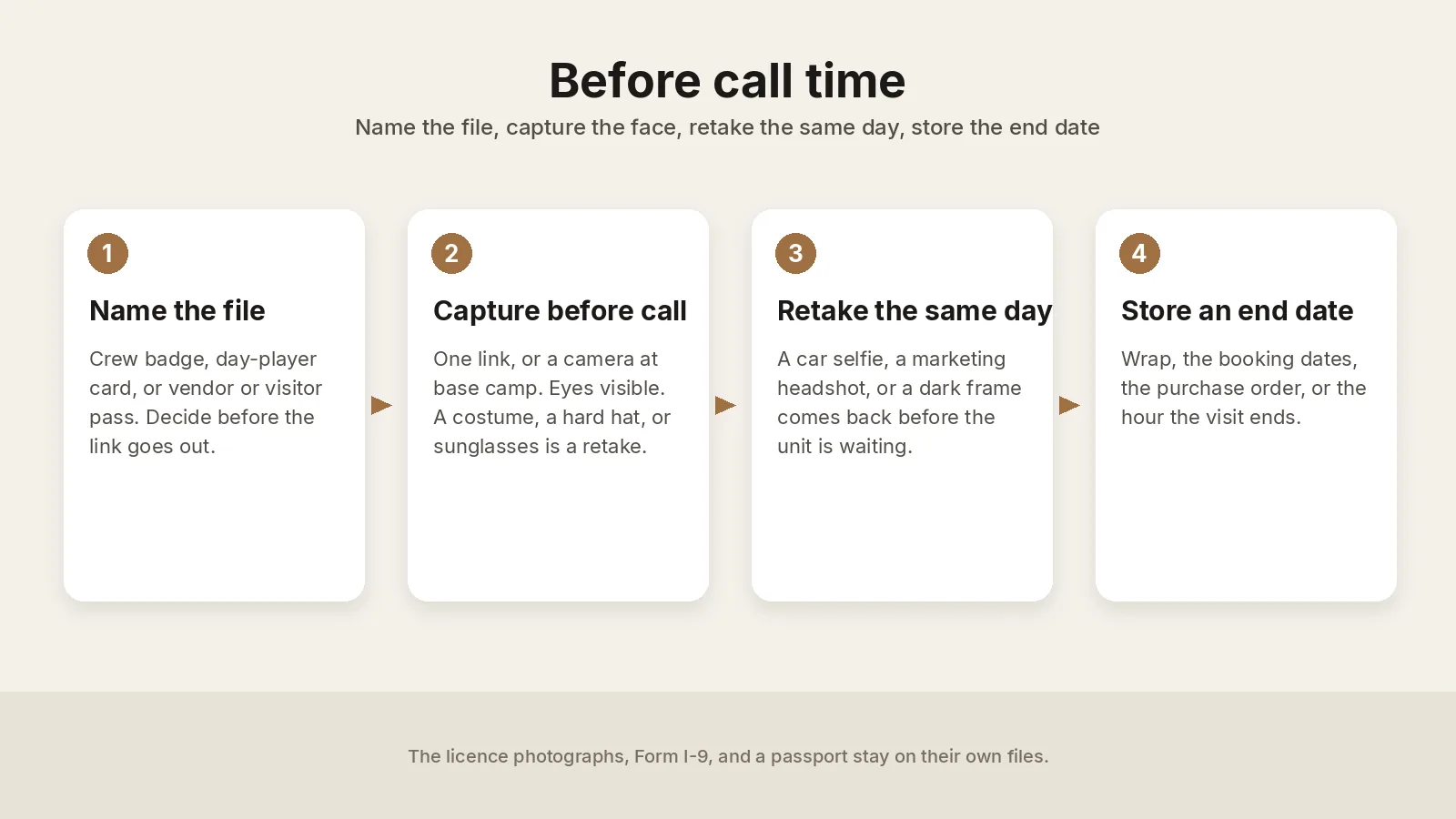
1. Write down who holds the camera. One person, eyes visible, on the link or at base camp. A costume, sunglasses, or a marketing headshot is a retake. A generated headshot stays on the marketing file.
2. Sort people by the record that already owns them. The crew badge ends on the wrap date. The day-player card ends on the booking. The vendor or visitor pass ends with the purchase order or the visit.
3. Collect the file on one link, or at base camp. The badge photo service emails one link per person, expired after use, available per request from support@idphoto.ai. Direct hires use the employee badge page. The link leaves the licence, the passport, and Form I-9 alone.
4. Reject a bad capture the same day. A photo compliance check can return a pass or a fail before you print. Background removal and photo enhancement apply only when the template allows them. A passport, a visa, or the licence pair stays unedited.
5. Write the file back with its date. Face comparison checks a replacement. Liveness detection is available per request on a phone capture. Take the copy back, or use a temporary link of 2 hours to 14 days, and deactivate the card on its date.
6. Batch one department on one template. Batch preparation returns a retake list before call. Print the three cards in three colors.
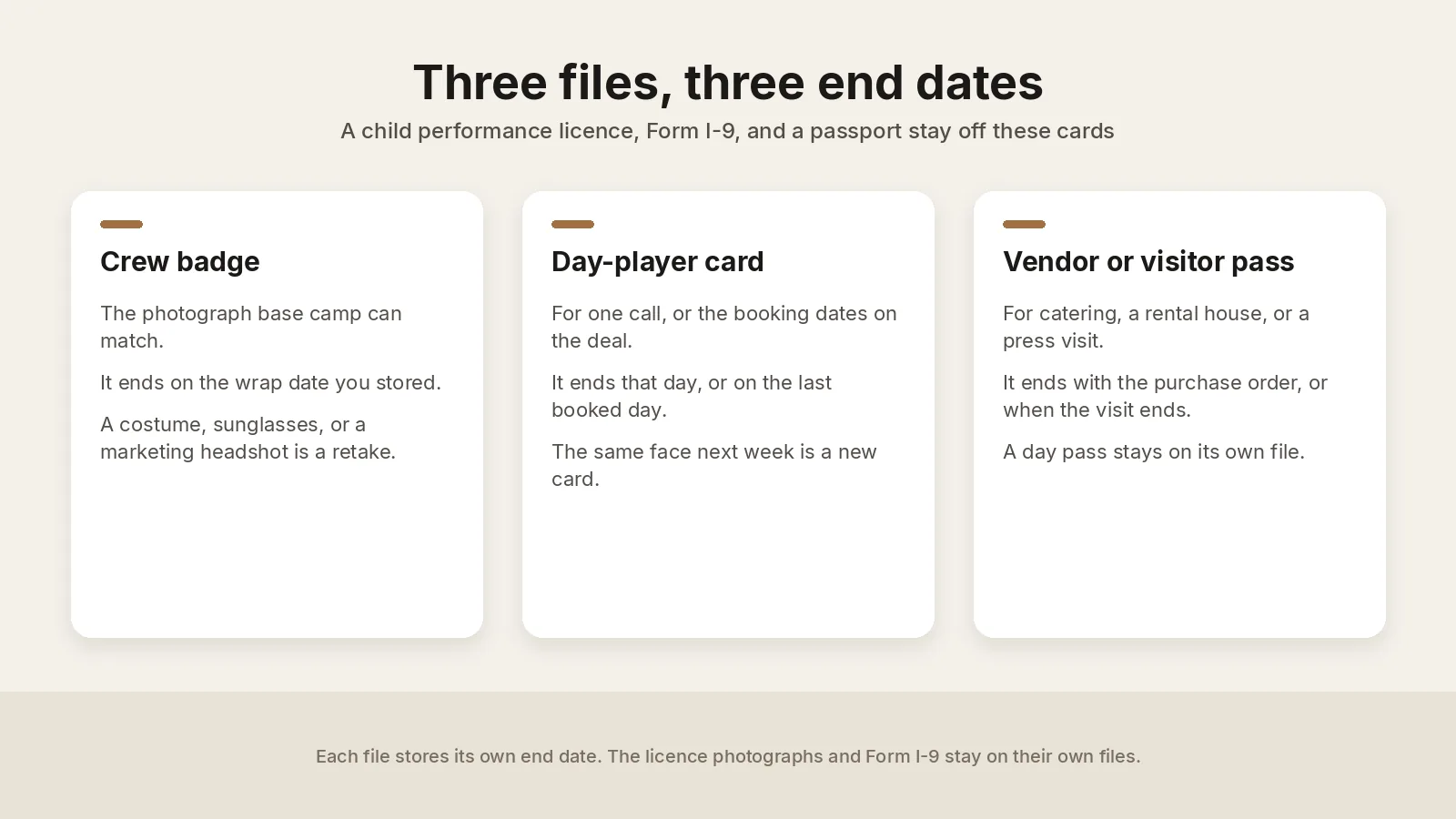
Print the name, the department, and the end date on the card. Keep the stage list on the access record. If someone will not reach a distant unit before call, confirm print and mailing, available per request, and match the face when they arrive.
What should a production require from a photo service?
| What you need | What good looks like |
|---|---|
| A specification per card | Size, crop, and background for each window. See the spec code reference. A passport, a visa, and the England licence photographs sit outside it. |
| Rejection before call | Face, light, blur, and framing the same day. A passport or a licence photograph stays unedited. |
| A path off base camp | One link per person, expired after use, plus a camera at base camp for the person who arrives without having used the link. |
| The record that owns the person | The file returns with its end date. Workday or SAP SuccessFactors sync is available per request for employees already in those systems. |
| A check a production assistant can explain | Face comparison and liveness detection are available per request. The production still decides who may enter. The location permit stays with the location manager. |
How do you roll this out on one unit first?
Write the file rule before the first link. Name the three templates, the end dates, and which stages each card opens. Name who completes Form I-9, who sends an England licence pack, and who holds the location permit on the day.
Run one unit for one week. Print one crew badge through a stored wrap date, one day-player card for a single call, one vendor pass through the purchase order, and one visitor pass that ends with the visit. Include a day player with no company email, and a hire whose job is shorter than three business days so Form I-9 is finished on the first morning.
Add the next unit after a write has held. Prove a clean upload, a same-day retake, and one failed write that is retried, then open the second unit on the same templates. Connect Workday or SAP SuccessFactors for employees only after support confirms it. A day player and a vendor stay off that sync. At wrap, delete the copies on the stored dates.
Where do set photos usually fail?
| What fails | What to change |
|---|---|
| A finished booking still opens the stage | Deactivate it on its date. Next week is a new file, in a different color. |
| A vendor is added as crew so the photo will sync | Keep them on the vendor pass. Form I-9 stays with their employer. |
| A marketing headshot or a costume is printed | Retake a plain capture, eyes visible, before call. A generated headshot stays on the marketing file. |
| The child's set pass is filed as the licence photographs | Send the council the pair Schedule 2 describes. Print the set pass from its own capture. The chaperone has a separate card. |
| The set pass is offered as Form I-9 proof, a passport, or a visa | Those records stay on the files that issued them. The pass is for base camp. |
| The location permit is treated as the face check | Keep the paper permit on site, as FilmLA instructs for the jurisdictions it serves. Match the face on the pass. |
Who may see a production photograph?
The person, production management for people the production employs, and the people who match a face may see the file that role needs. Delete the production's copy on the date stored with the file. GDPR Article 5(1)(e) and the CCPA apply where those laws apply. The data privacy policy covers encrypted transmission, a temporary link of 2 hours to 14 days, or taking the image back. US and EU processing are available. Other regions are available per request.
What do production managers ask?
Does every person on a production need a photograph on a set pass?
Print one where base camp matches a face to your record. The licence, the passport, and Form I-9 stay on their own files.
Can a marketing headshot go on the crew badge?
Capture a plain portrait, eyes visible. A costume, sunglasses, or a marketing headshot is a retake. A generated headshot stays on the marketing file.
Can a day player use the crew template?
Use the day-player card for that call. When the production employs the person for fewer than three business days, Form I-9 Sections 1 and 2 are due on the first day. Workday or SAP SuccessFactors sync is for employees already in those systems.
Can someone send a photo before the first call?
Yes. One link, expired after use, available per request from support@idphoto.ai. Keep a camera at base camp.
Do the England licence photographs replace the child's set pass?
Schedule 2 asks the council for two identical photographs taken in the six months before the application. The set pass is a separate file and ends on the last licensed day. The chaperone has their own pass.
Does a California entertainment work permit include the set photograph?
Title 8, section 11753, lists height, weight, and hair and eye color, and sets the permit at no more than six months. It does not list a photograph. Capture the set pass on its own link.
When should the photograph be deleted?
Delete the production's copy on the card's date. A later pickup is a new file. Form I-9 follows the Handbook. A licence follows the council.
What does preparing the photograph cost?
It starts at $0.20 per photo, separate from a printer, a badge system, and a permit fee. The catalog covers 300+ specifications across 200+ countries.
How does idphoto.ai fit this workflow?
The idphoto.ai API is the photo step. It prepares a portrait to the template you name, checks the capture, and returns a file for the crew record, the day-player record, the vendor or visitor record, or the printer. The production decides who receives a card and which stage it opens. A UK passport photo code retrieves a photograph that meets GOV.UK photo rules, and HM Passport Office still decides. Preparing a photo starts at $0.20.
Templates, the self-service link, Workday or SAP SuccessFactors sync, print and mailing, liveness detection, a face-mask check, another processing region, and the Shopify store template with one-click setup are each available per request. The store template stays off the production record. Email support@idphoto.ai with the card designs, which stages each pass opens, and how the file returns. Request samples stay in the API docs.
Where do these rules come from?
- BLS, Producers and Directors.
- Handbook for Employers, section 2.0, the Lists of Acceptable Documents, and the Justice Department's Form I-9 page.
- Children (Performances and Activities) (England) Regulations 2014, Schedule 2, and GOV.UK, Apply for a child performance licence.
- California Code of Regulations, title 8, section 11753, and FilmLA, Get a Film Permit.
- GOV.UK photo rules, right to work checks, and the Department of State photo page.