

An oil and gas operator can put a photograph a gate can match on an employee badge, on a contractor hitch card, and on a visitor pass, when it keeps those three files apart. Name the file before the crew mobilizes, capture the face before the hard hat goes on, and store an end date on every card the gate prints. A TWIC, a Form I-9 portrait, a process-safety training record, and a passport stay on the path that owns them.
Employees follow the employee badge page and the HR badge guide. Agency contractors follow the staffing guide and still need your hitch card. Guards follow the security guide, a local utility follows the utilities guide, a marine terminal follows the ports guide, and a pad still under construction follows the construction guide. A rotation visa follows the immigration guide.
What does one shared photograph cost an oil and gas site?
The cost shows up at the gate. The crew transport is in the lot, and the only picture on file is a selfie taken under a hard hat, with safety glasses still on. Last hitch's contractor card still opens the same gate. A visitor printed on the employee template walks the unit looking like someone who works there.
The U.S. Bureau of Labor Statistics counts about 112,700 jobs in 2025 across roustabouts, service unit operators, rotary drill operators, and derrick operators. About 72 percent are in support activities for mining. About 9,900 openings a year are projected, on average, from 2025 to 2035, mostly because people leave. Some crews on offshore rigs or in remote areas spend weeks away on long shifts. They usually wear hard hats and eye protection, so a job-site snapshot hides the face, and a once-a-year photo day misses the Monday hitch.
| File | Who it is for | When it ends | What goes wrong when the files are mixed |
|---|---|---|---|
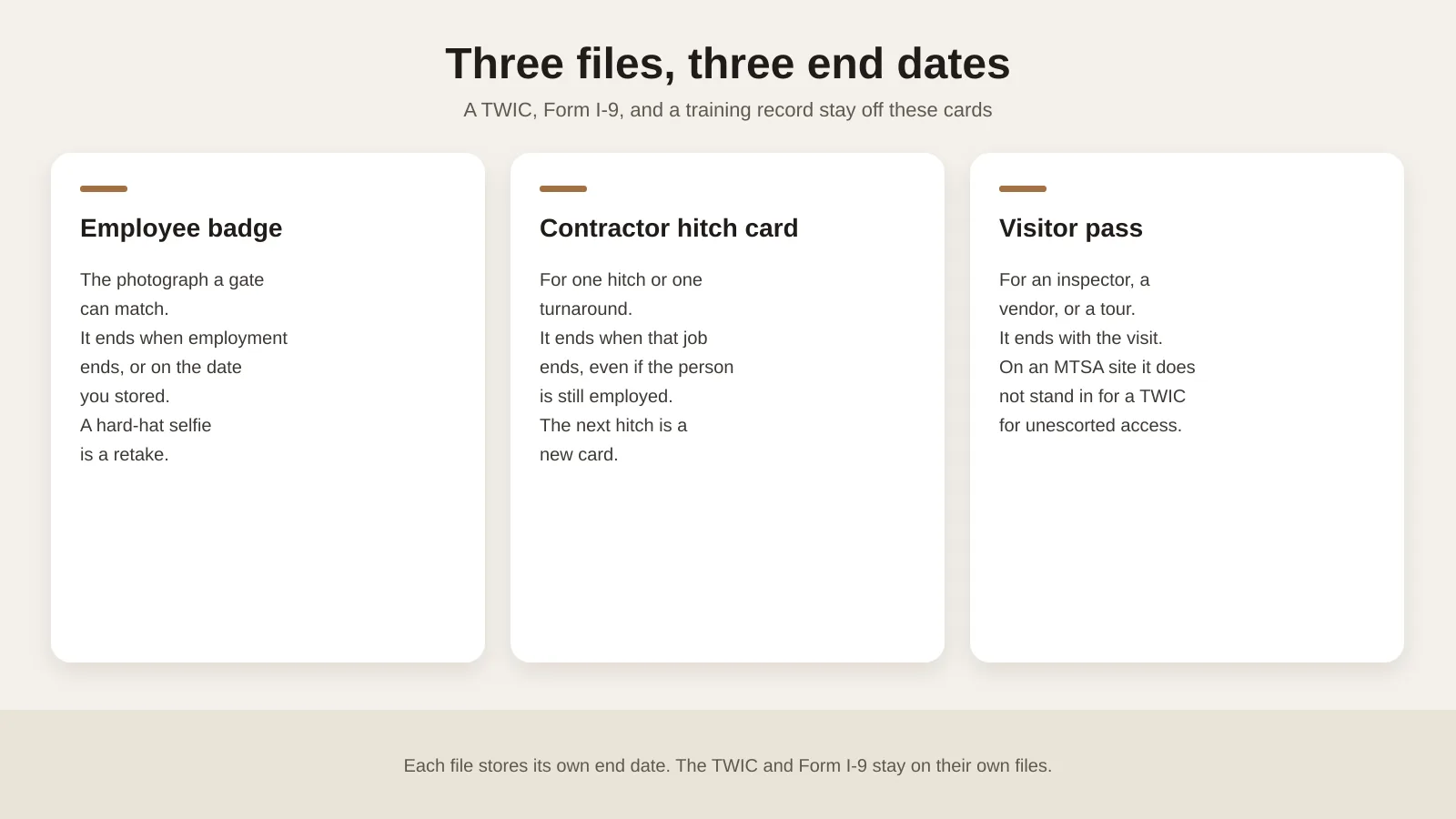
| Employee badge | An employee of the operator. | Employment ends, or the date you stored. | A hard-hat selfie, or no end date after the person leaves. |
| Contractor hitch card | One hitch, one purchase order, or one turnaround. | The last day of that job. | Last hitch's card still opens the gate, or a return is treated as a new hire. |
| Visitor pass | An inspector, a delivery, or a tour. | The visit. | A visitor who looks like an employee, or a finished visit that still opens the gate. |
| TWIC | Unescorted access on an MTSA-regulated vessel, facility, or outer continental shelf site. See 33 CFR 101.514. | The date TSA prints. A new card is $127 for five years. | Using the enrollment photo as Monday's site card. |
| Form I-9 | People the operator employs in the United States. The employee chooses the documents. A badge is off the Lists of Acceptable Documents. | The Handbook's clock. | Filing the site badge as proof of identity. |
| Training record | Where process safety management applies, the contract employer records identity, date, and how understanding was checked. See 29 CFR 1910.119(h)(3). | The training file's own clock. | Treating the badge as the training record. |
The Handbook for Employers requires Form I-9 when the operator hires someone in the United States. Section 2 is due within three business days, or on day one when the job lasts fewer than three. A right-to-work check happens before UK employment. The contractor's employer holds the contractor's form.
TSA takes the TWIC photograph at an application center and asks people to enroll at least 60 days ahead, because some applications take more than 45 days. Someone without a TWIC is escorted in a secure area, and 33 CFR 101.515 requires identification that shows the current face. 33 CFR 105.255 allows a visitor badge as one way to confirm the visit. An outer continental shelf facility follows 33 CFR part 106. A land well outside MTSA skips that row.
Where process safety management covers the process, 29 CFR 1910.119(h) controls entrance for turnaround contractors and leaves food, laundry, and delivery outside that paragraph. A scaffold crew takes a hitch card. A catering stop takes a visitor pass. The photograph is how the gate matches a face to the card.
Which file owns this photograph?
The operator sets the crop and decides which gate the card opens. The contractor still employs the person, so the hitch card ends with the hitch even when that job continues. An inspector may see the visitor portrait. Form I-9 and the training record stay back.
Employment, and the next hitch. Paid U.S. hires of the operator follow the Form I-9 rule above. A right-to-work check happens before UK employment. Workday or SAP SuccessFactors sync is for employees already in those systems. When a contractor returns, deactivate the old hitch card and open a new one. Adding the contractor as an employee so the photo will sync puts the wrong end date on the card.
A travel document, and a remote arrival. Capture the site portrait again. A UK passport photograph meets GOV.UK photo rules, and HM Passport Office still decides. A UK passport photo code retrieves it. A U.S. visa photograph follows the Department of State and stays unedited. Print and mailing, available per request, covers a card that has to exist before a remote arrival.
How do oil and gas sites collect these photos today?
One inbox holds the night-before replies: a hard-hat selfie, safety glasses still on, a group picture on the deck, and a passport scan meant for a visa. Someone crops them after the roster goes out. The crew mobilizes while the photo desk is closed, and last turnaround's card still opens the gate.
What does a split workflow look like?
On Monday 23 November 2026 one plant starts a turnaround through 12 December 2026. A company operator keeps the employee badge. A contractor whose hitch ended Friday 20 November 2026 gets a new hitch card, and the old card is deactivated. A scaffold vendor stays through 24 November. An inspector and a food delivery that Monday each get a visitor pass.
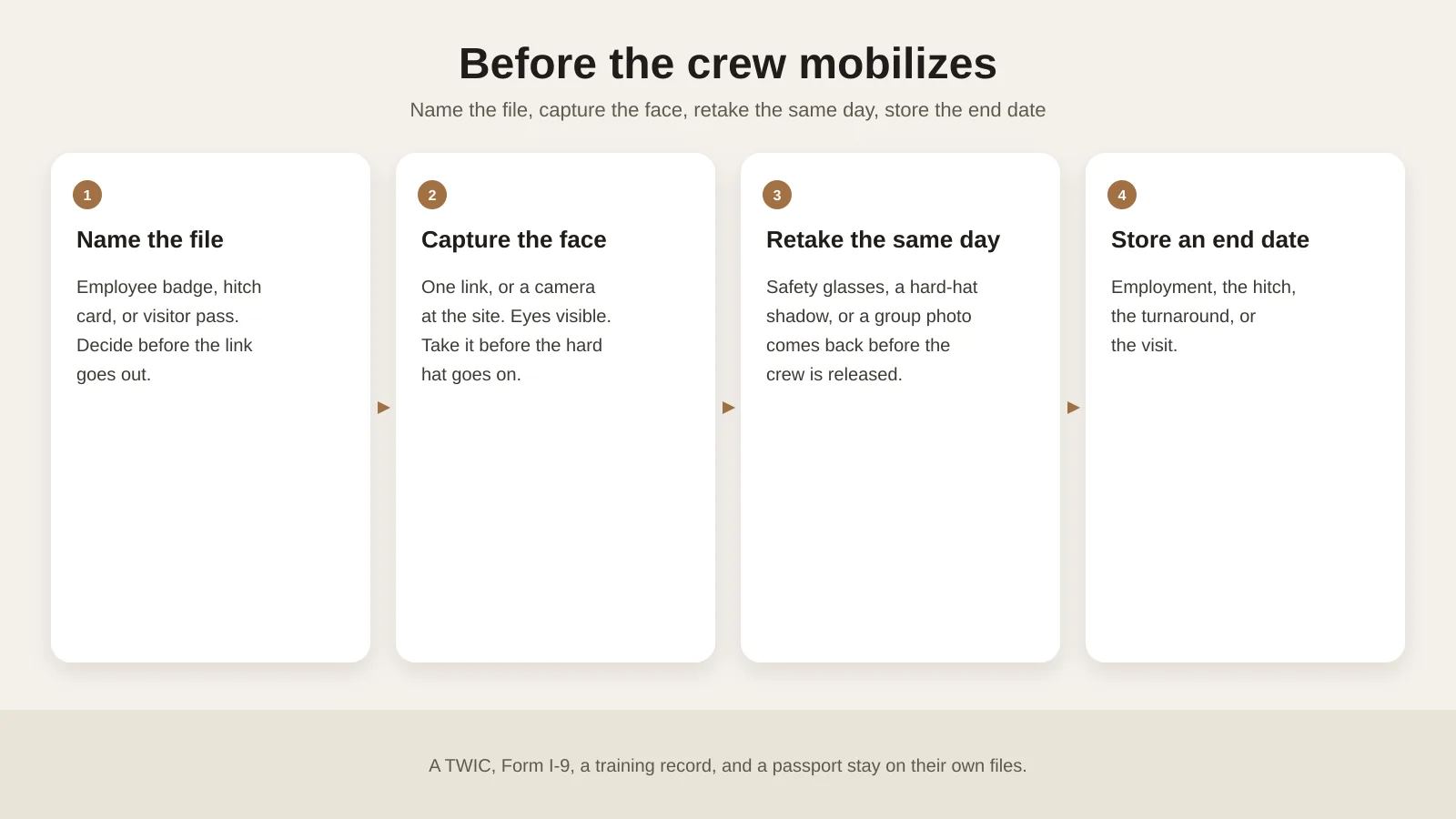
1. Write down who holds the camera. One person, eyes visible, on the link or at the site, before the hard hat and the safety glasses go on. A deck selfie or a shadow across the eyes is a retake. A generated headshot stays on the careers page.
2. Sort people by the record that already owns them. The employee badge follows employment with the operator. The hitch card ends on the last day of that hitch or turnaround. The visitor pass ends with the visit. The next hitch is a new card, and it leaves the TWIC where it is.
3. Collect the file on one link, or at the site. The badge photo service emails one link per person, expired after use, available per request from support@idphoto.ai. It leaves the TWIC, Form I-9, the training record, and the passport alone. A crew that mobilizes before the photo desk opens uses that link. Keep a camera at the site for anyone who did not. A hitch shorter than three business days still lets the operator's own new hire finish Form I-9 that first morning.
4. Reject a bad capture the same day. A photo compliance check can return a pass or a fail before you print. Background removal and photo enhancement apply only when the template allows them. A passport or a visa stays unedited. A face-mask check is available per request, and a respirator across the face is a retake. Send the common mistakes guide back while the person is still on the link.
5. Write the file back with its date. Face comparison checks a replacement. Liveness detection is available per request on a phone capture. Take the copy back, or use a temporary link of 2 hours to 14 days, and deactivate the card on its date.
6. Batch one crew on one template. Batch preparation returns a retake list before the crew is released. Print the three cards in three colors so a visitor pass is obvious without reading the name. On an MTSA site, that pass still leaves a person without a TWIC under escort.
What should an operator require from a photo service?
| What you need | What good looks like |
|---|---|
| A specification per card | Size, crop, and background per window. See the spec code reference. A TWIC, a passport, and Form I-9 sit outside it. |
| Rejection before the gate | Face, light, blur, and framing the same day, including a mobilization before the photo desk has opened. Leave a passport unedited. |
| A path off the headquarters camera | One link per person, expired after use, plus a camera at the site. |
| The record that owns the person | The file returns with its end date. Workday or SAP SuccessFactors sync is available per request for employees already in those systems. The hitch card stays separate. |
| A check a gate can explain | Face comparison and liveness detection, available per request. The operator still decides who may enter. |
How do you roll this out at one site first?
Write the file rule before the first link. Name the three templates, the end dates, and which gates each card opens. Name who completes Form I-9 for the operator's own hires, who runs a UK right-to-work check, who keeps the training record, and who checks a TWIC where the site is MTSA-regulated. A new hitch leaves the contractor employed, and it leaves the TWIC on its own date.
Run one site for one turnaround. Use 23 November 2026 through 12 December 2026. Include a contractor who sends the portrait from home, a paid hire whose first hitch is shorter than three business days, and one food delivery, so Form I-9, the hitch card, and the visitor pass are all tested that morning.
Add the next site after a write has held. Prove a clean upload, a same-day retake, and one failed write that is retried. Then open the second site on the same templates. Connect Workday or SAP SuccessFactors for employees only after support confirms it. Contractors and visitors stay off that sync. Delete each card copy on its date.
Where do site photos usually fail?
| What fails | What to change |
|---|---|
| Last hitch's card still opens the gate | Deactivate it on the hitch's last day. The next hitch is a new file, in a different color. Leave the employee badge in place. |
| A contractor is added as staff so the photo will sync | Keep the hitch card. Sync is for employees already in Workday or SAP SuccessFactors. |
| A visitor badge looks like an employee badge | Use a color a person can tell apart without reading the name. On an MTSA site, a person without a TWIC stays under escort. |
| The site badge is offered as a TWIC, Form I-9, a right-to-work check, or the training record | Those records stay on the files that own them. The card is for the gate. |
| The only portrait is a hard-hat selfie or a TWIC photocopy | Capture again with the eyes visible, before the crew is released. The TWIC stays in the worker's pocket. |
Who may see a site photograph?
The person, the people team, and the gate staff who match a face may see the file that role needs. A contractor's employer may see the hitch-card portrait when the contract says so. Delete the operator's copy on the card's date. GDPR Article 5(1)(e) and the CCPA apply where those laws apply. The data privacy policy covers encrypted transmission, a temporary link of 2 hours to 14 days, or taking the image back. US and EU processing are available. Other regions are available per request.
What do site security leads ask?
Does every person on site need a photograph on a badge?
Print one where a gate matches a face to your record. A TWIC, Form I-9, and the training record stay on their own files.
Can a hard-hat photo or a copy of a TWIC go on the site badge?
Capture a plain portrait, eyes visible, before the hard hat goes on. TSA takes the TWIC photograph at an application center.
Can a contractor hitch card use the employee template?
Store the job's last day on the hitch card. The next hitch is a new card. The employee badge stays for the operator's own people.
Can someone send a photo before mobilization?
Yes. One link, expired after use, available per request from support@idphoto.ai. Keep a camera at the site.
Does TWIC or process safety management require this photograph?
33 CFR 101.514 requires a TWIC for unescorted access on an MTSA-regulated site. 29 CFR 1910.119 requires control of entrance where it applies. The site card stores the end date and the face the gate matches.
Does the badge replace Form I-9, a right-to-work check, or the training record?
A badge is off the Lists of Acceptable Documents. A UK check happens before you employ someone. The training record stays with the contract employer.
When should the photograph be deleted?
Delete the operator's copy on the card's date. A new hitch is a new file. A TWIC follows the date TSA prints.
What does preparing the photograph cost?
See pricing. The catalog covers 300+ specifications across 200+ countries. The TWIC fee is paid to TSA.
How does idphoto.ai fit this workflow?
The idphoto.ai API is the photo step. It prepares a portrait to the template you name, checks the capture, and returns a file for the employment record, the hitch record, the visitor record, or the printer. The operator decides who receives a card and which gate it opens. A UK passport photo code retrieves a photograph that meets GOV.UK photo rules, and HM Passport Office still decides.
Templates, the self-service link, Workday or SAP SuccessFactors sync, print and mailing, liveness detection, a face-mask check, another processing region, and the Shopify store template with one-click setup are each available per request. The store template sells photos at a counter and stays off the site record. Email support@idphoto.ai with the card designs, which gates each pass opens, and how the file returns. Samples stay in the API docs.
Where do these rules come from?
- BLS Occupational Outlook Handbook, Oil and Gas Workers.
- TSA, Transportation Worker Identification Credential.
- 33 CFR 101.514, 33 CFR 101.515, 33 CFR 105.255, and 33 CFR part 106.
- OSHA 29 CFR 1910.119, paragraphs (f)(4) and (h). These apply where the process safety management standard covers the process.
- Handbook for Employers, section 2.0, the Lists of Acceptable Documents, retention, and the Justice Department's Form I-9 page.
- GOV.UK, checking a job applicant's right to work, GOV.UK photo rules, and the Department of State photo page.