
A cruise line can move a joiner from the airport to the gangway with a usable photograph when it keeps three files apart: the credential a government takes, the visa or passport photograph that document requires, and the badge for this ship. Name the file before anyone uploads, use the camera that file allows, and store an end date with the copy the ship keeps. TSA still takes the TWIC photograph. The consular officer still accepts the visa photograph. The gangway still decides who boards.
This guide is for the crew office, ship security, and the person who prints a badge when a joiner arrives. Shoreside payroll follows the HR badge guide. Agency hires follow the staffing guide. A contract guarding company follows the security guide. A visa or passport file follows the immigration guide. Starting from $0.20 per photo.
What does one photograph for every card cost a cruise line?
The cost is a joiner held at the gangway, a visa photograph sent back, or a badge that still looks current after the contract has ended. One JPEG cannot serve the TWIC, the visa, and this ship. The table uses published US rules, plus your template for every card the line prints. TSA, the Coast Guard, and the Department of State are not IDPhoto.ai customers.
| File | Who holds the camera | What goes wrong if you substitute |
|---|---|---|
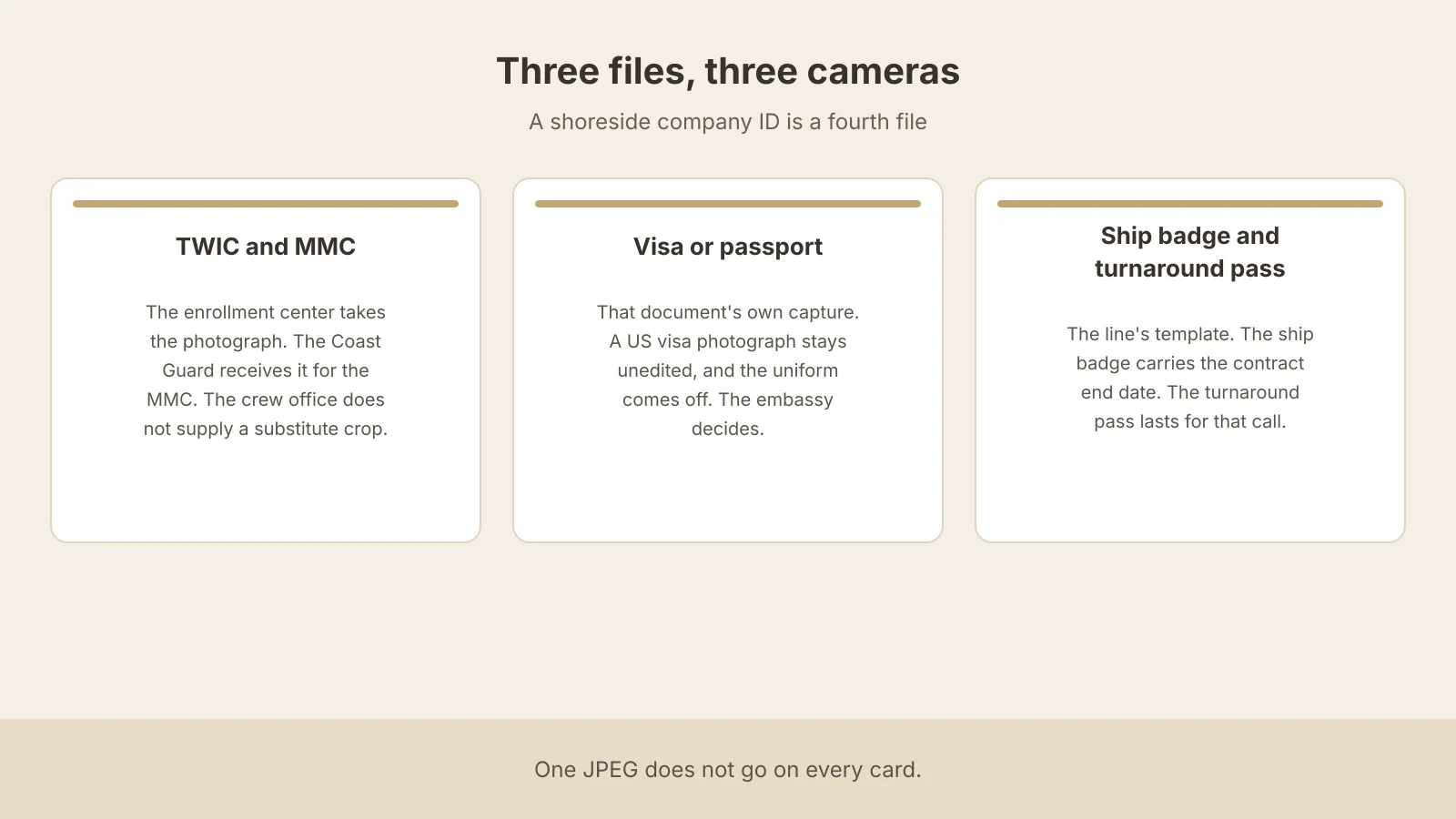
| TWIC, when this person needs unescorted access to a secure area | A TWIC application center. The applicant is fingerprinted there and a facial photograph is taken. | A ship-badge crop cannot become a TWIC. TSA lists a five-year fee: $127.00 new, $93.00 at the reduced rate on that page, $127.00 in person to renew, $119.00 online to renew, and $60.00 to replace. Enroll at least 60 days ahead. Processing for some applicants may exceed 45 days. |
| US Merchant Mariner Credential | The Coast Guard adds the TWIC enrollment photograph. See 46 CFR 10.209(e)(3). If it is missing, the mariner may visit a Regional Exam Center or an enrollment center. | An MMC is valid for five years. A mariner may not serve past expiration. A renewal window of up to 12 months does not extend that date. |
| C-1/D visa, when a foreign crew member joins a ship in the United States | The applicant uploads a photograph with the DS-160. If the upload fails, they bring a printed photograph to the interview. See the crewmember visa page. | It has to meet Department of State photo rules and stay unaltered, with the uniform off. The embassy decides. |
| This ship's crew badge | Your template: a phone link before joining, or the camera at the crew office. | A cabin selfie the gangway cannot match, or an end date that lives only in the crew scheduler. |
| Turnaround visitor, contractor, harbor pilot, or surveyor | A fresh capture for that call. | Yesterday's crew file printed as a day pass. |
33 CFR 104.265 requires the vessel to control access. An unescorted person stays out of a secure area unless they hold a duly issued TWIC and are authorized to be there. A person without a TWIC still shows identification and a reason for boarding, which can be a visitor badge from the vessel's own system. The crew-card photograph shows who you authorised, and until when. TSA publishes canceled-card lists. A current ship file does not show that a TWIC was canceled.
How do cruise lines collect crew photos today?
Most crew offices still run on a webcam, a shared inbox, and one coordinator. A joiner texts a selfie from the airport, uniform on. Someone crops it once for the visa, the ship badge, and the turnaround log. The end dates sit in three places, so a reprint uses whichever file is newest, and the person waits at the gangway.
What does a split workflow look like?
Name the file before the first link goes out. One person can hold more than one file. Each file has its own camera and its own end date.
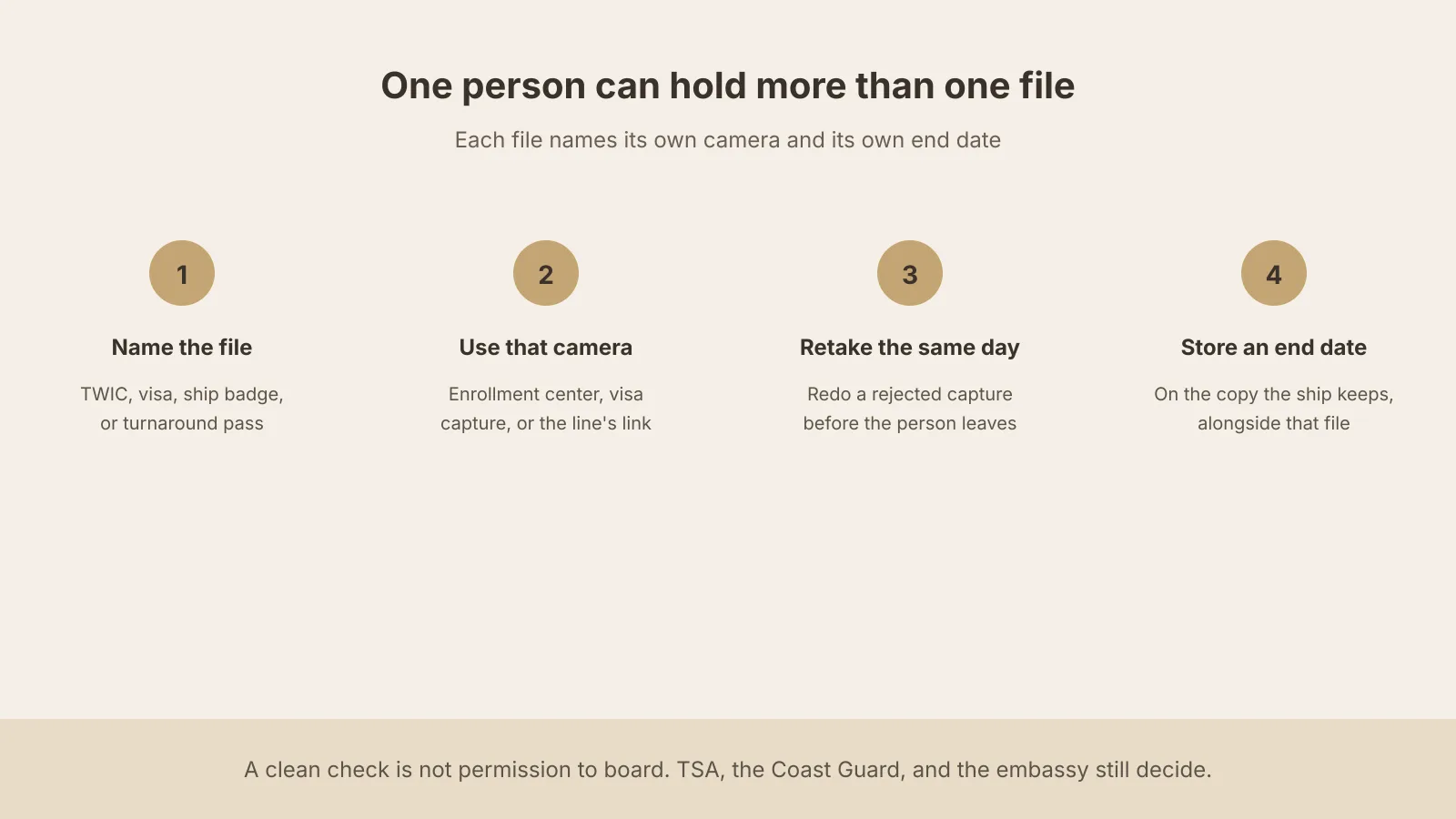
1. Write down who is allowed to hold the camera. Use the row above. Collect the ship photograph before the joining date. The enrollment center keeps the TWIC camera. The visa capture stays on the visa.
2. Sort people by the record that already owns them. Build the checklist on the crew record. Leave payroll, the staffing assignment, and the government account where they already live.
| Who | Where the record lives | What to do with the photo |
|---|---|---|
| Direct employee, including shoreside staff who also sail | The company record, and HR when Workday or SAP SuccessFactors already lists them | Company template and employment end date. A second file when this contract ends sooner. |
| Officer or rating joining this ship | The assignment on this ship | This ship's template and the day the contract ends. |
| Entertainer or concession crew from a staffing firm | The assignment | The card you issue, with the assignment end date. The firm keeps its own file. |
| Visitor, harbor pilot, surveyor, or a contractor on turnaround | The visitor log | A fresh capture for that call. A visitor badge can confirm why a person without a TWIC is boarding. |
| Crew member who also needs a visa or a passport | That document's own file | The immigration guide. A UK passport photograph meets GOV.UK photo rules and stays unedited. |
3. Collect the ship and company files on one link, or on a camera at the crew office. The badge photo service can email a unique link with no extra account, and the link expires after use. That portal is available per request. Contact support@idphoto.ai. Keep the crew-office camera for a rejected capture. The TWIC and the visa keep their own cameras. Shoreside staff can use the same capture on the employee badge page.
4. Match the face, and reject a bad capture in the same visit. One person, in colour, in focus, eyes visible. A US visa photograph leaves the uniform off and stays unedited. Eyeglasses come off except in the rare medical case on the visa photo page. The TWIC photograph follows the enrollment center: hats come off unless worn daily for religious reasons, and everyday eyeglasses may stay when they do not hide the eyes. The ship badge follows your template, so the uniform can stay when the gangway will match the person that way. Background removal and photo enhancement apply only on a template that allows them. A UK passport photograph must meet GOV.UK photo rules and stay unedited. HM Passport Office still decides. A face-mask check is available per request. An AI headshot is a different file.
5. Write each file to the record with the date it should stop. A clean check means those capture problems were not reported. TSA, the Coast Guard, the embassy, and the gangway still decide. On a replacement, face comparison returns a match decision and a similarity score. Liveness detection is available per request. See biometric verification. Take the copy back, or use a temporary link of 2 hours to 14 days. That window is not the retention schedule.
6. Run a batch only inside one specification. Batch preparation fits a week of joiners on this ship's template and returns a retake list. The TWIC photograph, the visa photograph, the ship badge, and the turnaround pass stay in separate batches.
Many crew-office printers take ID-1 stock, nominally 85.60 mm by 53.98 mm under ISO/IEC 7810. Measure the photo window before the first link. Keep a passport number off the face of the card. While a TWIC is valid, 46 CFR 10.203(c) calls it the mariner's primary identification document. The ship card does not stand in for it.
Where do crew photos usually fail?
These breaks show up after the joining date, or when the gangway asks for a file the crew office cannot open.
| What fails | What to change |
|---|---|
| One selfie is cropped for the TWIC, the visa, and the ship badge | Split the files before the link goes out. Each file names its camera and its end date. |
| The uniform stays on a US visa photograph | Retake that file without the uniform. Keep the uniform on the ship badge only when the template says so. |
| The visa file was background-removed or sharpened | Leave it unaltered. The Department of State says a visa photograph must not be digitally altered. |
| A ship badge is handed over as a TWIC or an MMC | TSA issues the TWIC. The Coast Guard issues the MMC. Store the reference and the expiry. Check TSA's canceled-card lists before you treat a TWIC as current. |
| The contract has ended and the badge still looks current | Store the end date with the photo, and deactivate the card that day. |
| The only copy sits in a coordinator's inbox | Store it where the gangway and the crew office can open it on the joining day. |
What should a cruise line require from a vendor?
The crew office and the person who owns gangway access can share one shortlist. TSA, the Coast Guard, and the embassy still issue their own documents.
| What you need | What good looks like |
|---|---|
| A specification per card you print | Size, crop, background, uniform, and glasses. See sample specifications. The TWIC and the visa sit outside this list. |
| A block on forbidden edits | A US visa photograph, and a US or UK passport photograph, stay unedited. See when a corrected portrait fits. |
| Rejection before a manual crop | Face, light, blur, framing, glasses, and a turned head, while the person is still there. A face-mask check when you ask for it. |
| A path for people not yet at the ship | One link per person, no extra account, expired after use. The crew-office camera stays for a rejected capture. |
| The crew record | The file returns with the date that card should stop. Workday or SAP SuccessFactors sync is available per request. |
| A check a gangway officer can explain | Face comparison and liveness detection are available per request. The officer still matches the person. |
Who may see a crew member's photograph?
The crew member, the crew office, and the gangway may see the ship file. A department head sees that contract when the agreement says so. TSA sees the TWIC. The embassy sees the visa. A publicity photograph for a brochure uses a separate consent. Government ID numbers stay in the system that already holds them.
In the UK and the EU the portrait is personal data under the GDPR. In California it is personal information under the CCPA. The data privacy policy describes encrypted transmission, temporary storage from 2 hours to 14 days, or taking the image so nothing is retained on the service. US and EU processing are available. Other regions are available per request. The TWIC record stays with TSA, and the visa record stays with the embassy.
How do you roll this out on one ship?
Write the file rule before the first link. For one ship, name the crew template, the credentials that ship asks for, and the turnaround pass. Write the date that stops each file, and measure the photo window on that printer. A shipyard badge during dry dock follows the contractor guide.
Run one week of joiners on the ship template only. Name one owner who can decide, the same day, whether a person stays on the new path. A rejected capture uses the crew-office camera before the person leaves. Print one card on that printer, or confirm print and mailing with support before you promise a photograph in the post. Print and mailing is available per request.
Add a second ship after a write has held. Prove a clean upload, a retake, and a write that fails once and is retried. Open Workday or SAP SuccessFactors only after support has confirmed that connection. The Shopify store template, with one-click setup, is available per request for a public counter. It follows the Shopify guide and stays off the crew record.
What do crew-office leads ask?
Can the crew office upload its own crop as the TWIC photograph?
No. TSA takes that photograph at the application center, and 46 CFR 10.209(e)(3) says the Coast Guard receives it from TWIC enrollment. The ship badge is a separate file.
Does a ship badge replace a Merchant Mariner Credential?
No. An MMC is valid for five years, and a mariner may not serve under it past the expiration date. The 12-month renewal grace does not extend that date.
Can a crew member wear a uniform in the visa photograph?
For a US visa, the photo rules say the uniform stays off, except religious clothing worn daily, and the file must not be digitally altered. The ship badge can keep the uniform when the template says so.
Can a joiner submit a ship-badge photo before reaching the ship?
Yes. Send one link, with no extra account, and expire it after use. It is available per request. Contact support@idphoto.ai. Keep the crew-office camera for a rejected capture. TSA still holds the camera for the TWIC.
What if the person comes from a staffing agency, or works shoreside?
The firm keeps its own file under the staffing guide. You still print this ship's badge with the assignment end date. Shoreside staff follow the HR badge path. A guarding company follows its licence and company ID. A dry-dock yard follows the contractor guide.
Can the same portrait go on a UK passport?
Use a separate file, on the immigration path. A UK passport photograph must meet GOV.UK photo rules, stay unedited, and can be retrieved with a UK passport photo code. HM Passport Office still decides.
How does idphoto.ai fit this workflow?
idphoto.ai is the photo step for the cards the line prints. The API prepares a portrait to the template you name, checks the capture, and returns a file for the crew record or the printer. TSA issues the TWIC. The Coast Guard issues the MMC. The embassy accepts the visa photograph. The gangway decides who boards. The catalog covers 300+ specifications across 200+ countries. Starting from $0.20 per photo. A UK passport photograph must meet GOV.UK photo rules. A visa photograph the applicant supplies stays unedited.
Templates, the self-service link, Workday or SAP SuccessFactors sync, print and mailing, liveness detection, a face-mask check, another processing region, and the Shopify store template with one-click setup are each available per request. Email support@idphoto.ai with the card designs, which credentials the ship asks for, how the file returns, and any turnaround template that differs from the crew badge.