
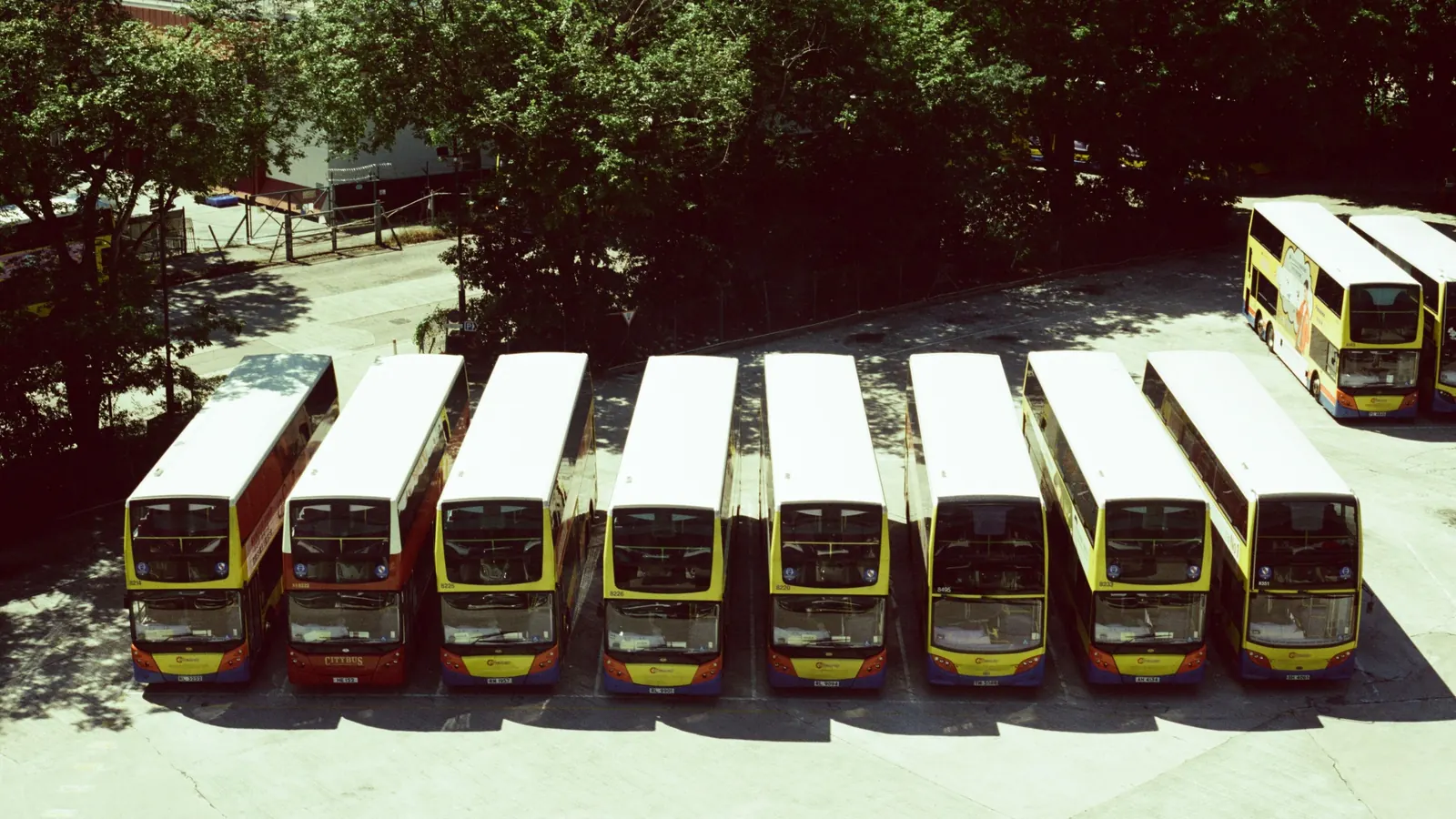
A public transit agency can put a photograph a yard, a station, or a supervisor can match on an operator badge, on a contractor card, and on a yard or station pass, when it keeps those three files apart. Name the file before anyone uploads, capture the face before the first pull-out, and store an end date on every card the agency prints. A commercial license photograph, a drug-and-alcohol testing record, a Driver CPC card, and a Form I-9 portrait stay on the path that issued them.
Payroll employees follow the employee badge page and the HR badge guide. A staffing-firm extra board follows the staffing guide and still needs your yard pass. A non-revenue truck follows the fleet guide, an airport secure area follows the airport guide, school service follows the school-district guide, and armed contract security follows the security guide. Starting from $0.20 per photo.
What does one shared photograph cost a transit agency?
The cost shows up at pull-out. A supervisor holds a run because the new operator's only picture is a selfie taken in the cab. A card from a finished paratransit contract still opens the yard. One crop is asked to serve the badge, the license, and a passport.
The U.S. Bureau of Labor Statistics counted about 158,800 jobs for bus drivers, transit and intercity, in 2024. Local government, excluding education and hospitals, employed 54 percent, and urban transit systems 17 percent. Employment is projected to grow 4 percent from 2024 to 2034, to about 165,600. BLS says these drivers must have a commercial driver's license. The badge covers your roster. A driver on a contractor's payroll still needs your yard pass. School bus drivers, about 387,300 jobs in 2024, are a separate count.
| File | Who holds the camera | What goes wrong when the files are mixed |
|---|---|---|
| Operator badge | A link before day one, or the division camera. | A cab selfie, sunglasses, or a card with no end date. |
| Contractor card | That contract's template, before the first pull-out. | A finished contract still opening the yard, or a contractor created as an employee. |
| Yard or station pass | A trainer, a vendor, or a trainee still on a permit. | A day pass reused as a key, or a trainee badged as a revenue operator. |
| Commercial license, where the bus is a CMV | The licensing state. 49 CFR 383.153 puts a photograph on a CDL. A temporary CDL may omit it for 60 days or less. | Cropping the license onto the badge. |
| Testing record, where 49 CFR Part 655 applies | The employer that runs the program. | Using the badge as the testing record. |
| Driver CPC card, Great Britain | The photocard licence. GOV.UK uses that photograph. | Offering the company badge at a roadside check. |
| Form I-9, for people the agency employs in the United States | The employee chooses the documents. A badge is not on the Lists of Acceptable Documents. | Filing the badge as proof of identity, or specifying which document to bring. |
The Handbook for Employers requires Form I-9 for someone you hire in the United States for pay, with Section 2 due within three business days, or on day one if the job is shorter. Skip it for an independent contractor, for a contractor's employee, and, under the instructions, for someone paid nothing, such as an unpaid volunteer. On an E-Verify case, compare the photo E-Verify displays with the document presented. Retention follows the Handbook.
Which file owns this photograph?
The agency sets the crop and still decides which gate the card opens. The license, the testing record, and Form I-9 each keep their own record.
Where the bus is a commercial motor vehicle. 49 CFR 383.5 includes a vehicle designed to transport 16 or more passengers, including the driver, and a vehicle of 26,001 pounds or more. FMCSA guidance counts designated seats, not standing room. Read that test before you treat a cutaway as a CDL vehicle. 49 CFR 383.93 requires a passenger endorsement. The state keeps the photograph in 49 CFR 383.153. A temporary CDL may omit it only for 60 days or less. A learner's permit may omit a photograph, and with a passenger endorsement it may carry only auditors, inspectors, examiners, other trainees, and the accompanying CDL holder. A trainee uses the yard or station pass until that license is in hand.
Where the agency receives FTA funds. 49 CFR 655.3 applies Part 655 to a recipient or subrecipient of 49 U.S.C. 5307, 5309, or 5311, and to their contractors. 49 CFR 655.4 lists the safety-sensitive work, including operating a revenue vehicle even off revenue service, dispatch, maintenance with the small-urban and rural exceptions written there, and carrying a firearm for security. A volunteer is covered for that testing only if a CDL is required to drive, or if that work pays more than actual expenses. An unpaid volunteer can sit outside Form I-9 and inside that testing rule. The testing file is not the badge.
Where a contractor runs the service. Section 655.4 treats an ongoing written or informal arrangement as the contractor relationship. The card ends on the stored contract date. That employer completes Form I-9 for its own people. Workday or SAP SuccessFactors sync is for employees already in those systems.
Where the operator drives a bus in Great Britain. GOV.UK requires the Driver CPC card while driving professionally, sets a £50 fixed penalty for driving without it, and uses the photocard licence photograph. DVSA also expects a digital driver card when one has been issued. Read the waiting rules there before a missing card becomes a badge problem. A right-to-work check happens before employment. A UK passport photograph meets GOV.UK photo rules, and HM Passport Office still decides.
Where the property also runs rail or a ferry. Section 655.3 sends railroad operations the Federal Railroad Administration regulates to 49 CFR Part 219, and leaves other operations on Part 655. A ferry reads the exception in 655.3(c). The station still matches a badge. The testing file follows the rule that applies.
Where the route crosses a regulated door. A TWIC under 33 CFR 101.514 is the maritime credential. Read TSA's page. An airport secure area uses the airport medium. The company badge is the yard's file.
How do agencies collect these photos today?
One inbox holds the Monday class, the paratransit operator, the trainer, and a photo of a license. The division prints whatever arrived, and the yard guesses which card still opens after the contract ends.
What does a split workflow look like?
Name the file before the first link goes out. Every card stores an end date. One Monday at a single division: two new operators, a paratransit contractor whose contract you stored as ending on 30 June 2027, and a trainer through Friday. Four links go with the offers. The division camera is the retake. The license stays on the license file.
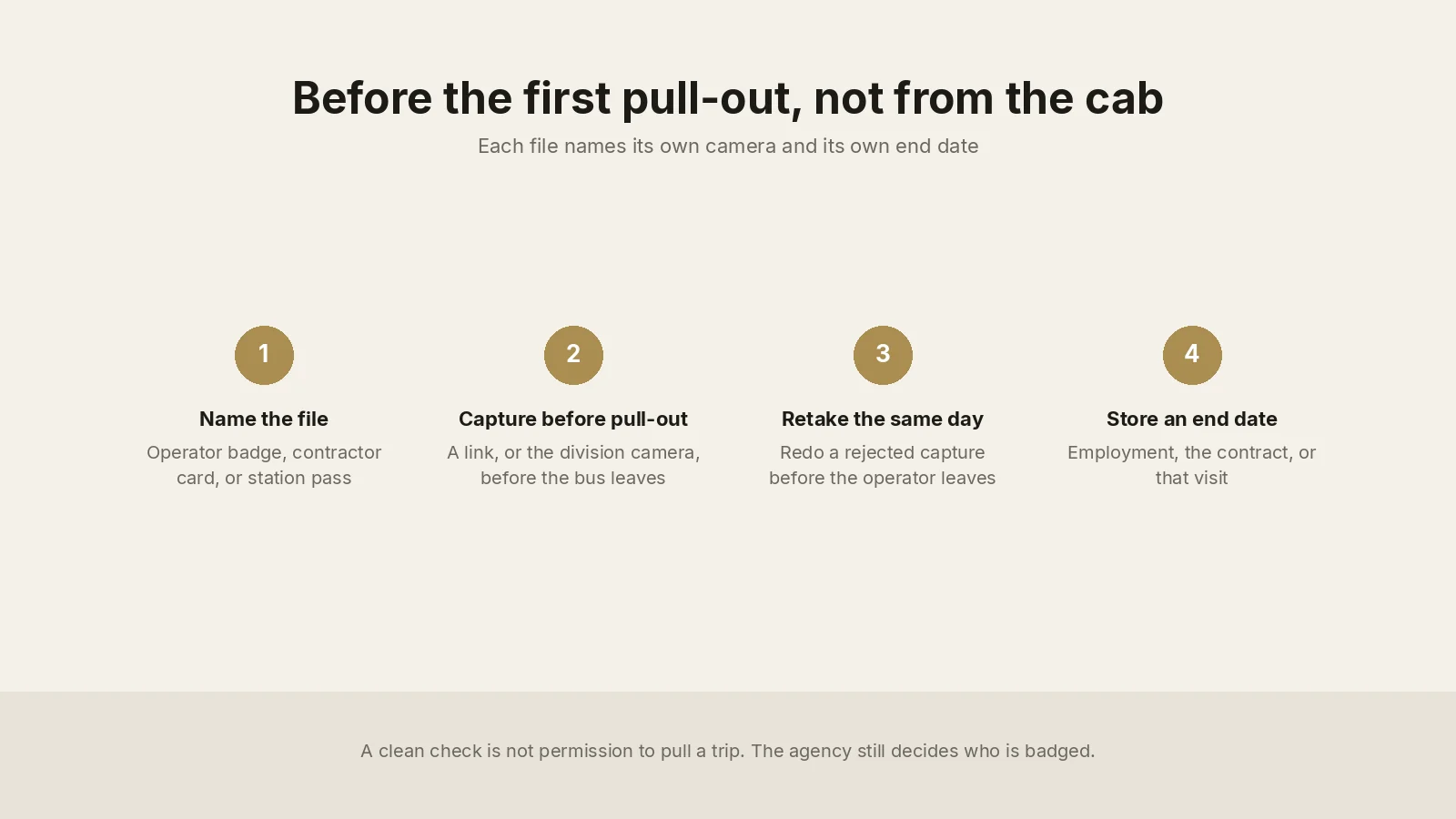
1. Write down who holds the camera. Collect on the link or at the division before the bus leaves: one person, eyes visible. Sunglasses, a hood, or the bus is a retake.
2. Sort people by the record that already owns them. The operator badge ends with employment, the contractor card on the contract date, and the yard or station pass with that visit. Another site can still require its own pass the same morning.
3. Collect the file on one link, or at the division. The badge photo service emails one link per person, expired after use, available per request from support@idphoto.ai. Direct hires use the employee badge page. The link leaves the license, the testing record, and Form I-9 alone.
4. Reject a bad capture in the same visit. A photo compliance check can return a pass or a fail before you print. Background removal and photo enhancement apply only when the template allows them. A license or a UK passport photograph stays unedited. See when a corrected portrait fits.
5. Write the file back with its date. Face comparison checks a replacement. Liveness detection is available per request on a phone capture. Take the copy back, or use a temporary link of 2 hours to 14 days, and deactivate the card on its date.
6. Batch one class on one template. Batch preparation returns a retake list before the buses leave. Print the three cards in three colors.
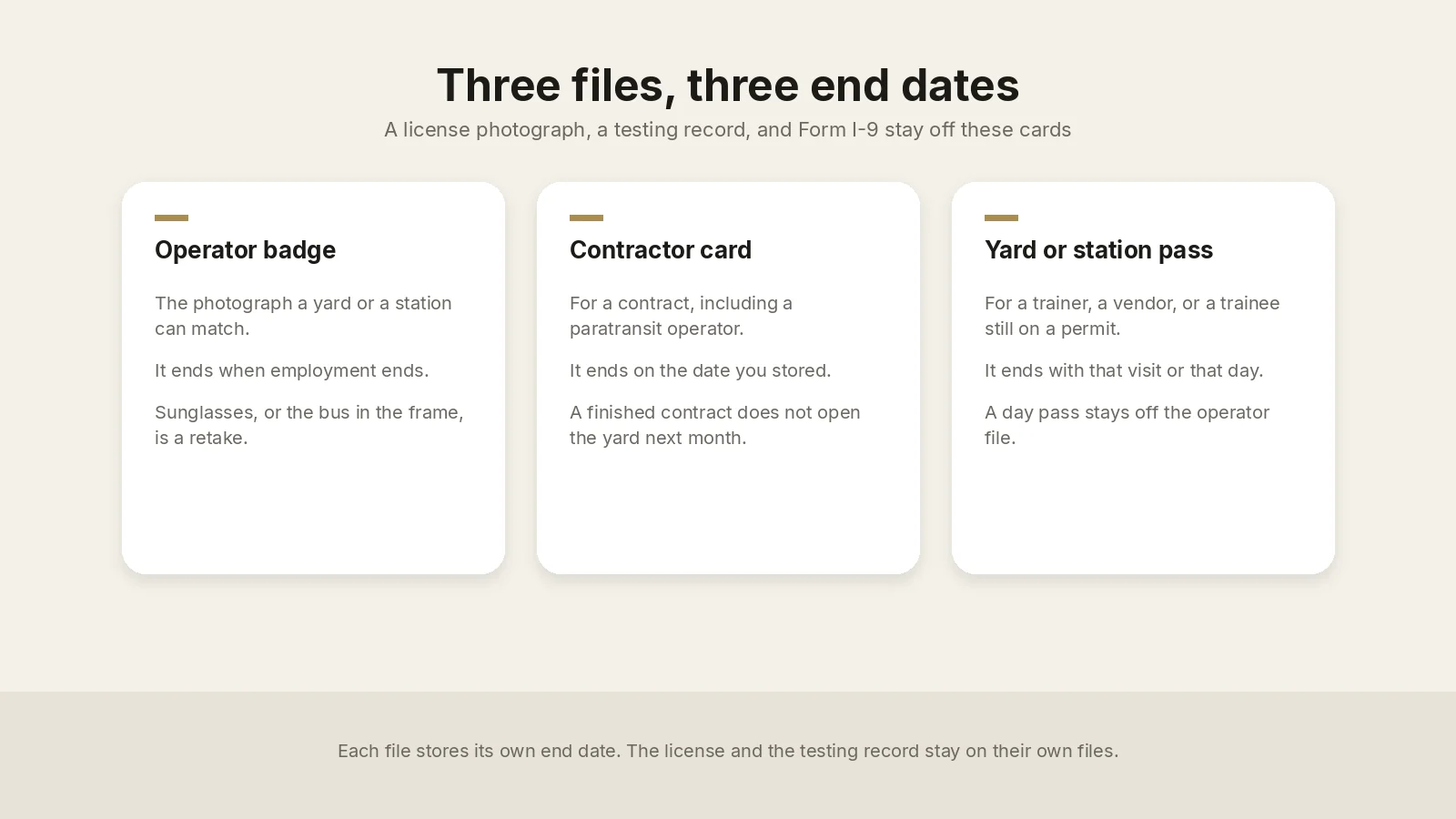
Print the name, the role, the division, and the end date on the card. Keep the route list on the access record.
What should transit operations require from a photo service?
| What you need | What good looks like |
|---|---|
| A specification per card | Size, crop, and background for each window. See the spec code reference. A license and a TWIC sit outside it. |
| Rejection before the bus leaves | Face, light, blur, and framing the same day. A license photograph stays unedited. |
| A path off the division | One link per person, expired after use, plus a camera at the division. |
| The record that owns the person | The file returns with its end date. Workday or SAP SuccessFactors sync is available per request for employees already in those systems. |
| A check a yard officer can explain | Face comparison and liveness detection are available per request. The agency still decides who may pull a trip. |
How do you roll this out at one division first?
Write the file rule before the first link. Name the three templates, the end dates, and which gates each card opens. Mark an airport, a school, or a port route. Name who completes Form I-9 and who keeps the testing record.
Run one division for one class. Print two operator badges, one contractor card on the stored date, and one station pass that ends that day. Include an operator with no company email and a trainee still on a permit. If they will not come in first, confirm print and mailing, available per request, and match the face at the yard.
Add the next division after a write has held. Prove a clean upload, a retake, and one failed write that is retried. Then open the next garage. Connect Workday or SAP SuccessFactors for employees only after support confirms it. A contractor and a staffing-firm extra-board hire stay off that sync.
Where do operator photos usually fail?
| What fails | What to change |
|---|---|
| A finished contract still opens the yard | Deactivate it on its date. A new contract is a new file, in a different color. |
| A contractor is added as an employee so the photo will sync | Keep them on the contractor card. Form I-9 stays with their employer. The testing file follows Part 655 where that part applies. |
| A trainee on a learner's permit is printed as a revenue operator | Use the yard or station pass until the route's license is in hand. Read the passenger limit in 49 CFR 383.153. |
| The badge is offered as a CDL, a Driver CPC card, a TWIC, or a testing record | Those credentials stay on the files that issued them. The badge is for the yard and the station. |
Who may see an operator photograph?
The person, the people team for employees, and the officers who match a face may see the file that role needs. Delete the agency's copy on the date stored with the file. GDPR Article 5(1)(e) and the CCPA apply where those laws apply. The data privacy policy covers encrypted transmission, a temporary link of 2 hours to 14 days, or taking the image back. US and EU processing are available. Other regions are available per request.
What do transit operations leads ask?
Does every operator need a photograph on the company badge?
Print one where a yard, a station, or a supervisor matches a face to your record. The license, the testing record, and Form I-9 stay on their own files.
Can the license photograph go on the operator badge?
The state keeps the photograph it took. Capture the badge on its own link. See 49 CFR 383.153.
Can a contractor use the employee template?
Use the contractor card for that contract. Form I-9 stays with that employer. Workday or SAP SuccessFactors sync is for employees already in those systems.
Can an operator send a photo before the first pull-out?
Yes. One link, expired after use, available per request from support@idphoto.ai. Keep a camera at the division.
Does the company badge replace a CDL, a Driver CPC card, or a testing record?
No. The license, Part 655 or Part 219, and the Driver CPC card each stay on their own file.
Can a trainee on a learner's permit pull a revenue trip?
Use the yard or station pass until the route's license is in hand. 49 CFR 383.153 limits who a permit holder may carry.
When should the photograph be deleted?
Delete the agency's copy on the card's date. Form I-9 and the testing record follow their own clocks.
What does preparing the photograph cost?
It starts at $0.20 per photo, separate from a printer, a badge system, and a government fee. The catalog covers 300+ specifications across 200+ countries.
How does idphoto.ai fit this workflow?
The idphoto.ai API is the photo step. It prepares a portrait to the template you name, checks the capture, and returns a file for the operator record, the contractor record, the yard-pass record, or the printer. The agency decides who receives a card and which gate it opens. A UK passport photo code retrieves a photograph that meets GOV.UK photo rules, and HM Passport Office still decides. Preparing a photo starts at $0.20, from a catalog of 300+ specifications across 200+ countries.
Templates, the self-service link, Workday or SAP SuccessFactors sync, print and mailing, liveness detection, a face-mask check, another processing region, and the Shopify store template with one-click setup are each available per request. The store template stays off the operator record. Email support@idphoto.ai with the card designs, which gates each pass opens, and how the file returns. Request samples stay in the API docs.
Where do these rules come from?
- BLS, Bus Drivers: 2024 job counts and the 2024–34 projection.
- 49 CFR 383.5, 383.93, 383.153, and FMCSA seat guidance.
- 49 CFR 655.3 and 655.4, plus the Handbook for Employers.
- GOV.UK Driver CPC, GOV.UK photo rules, and TSA TWIC.