
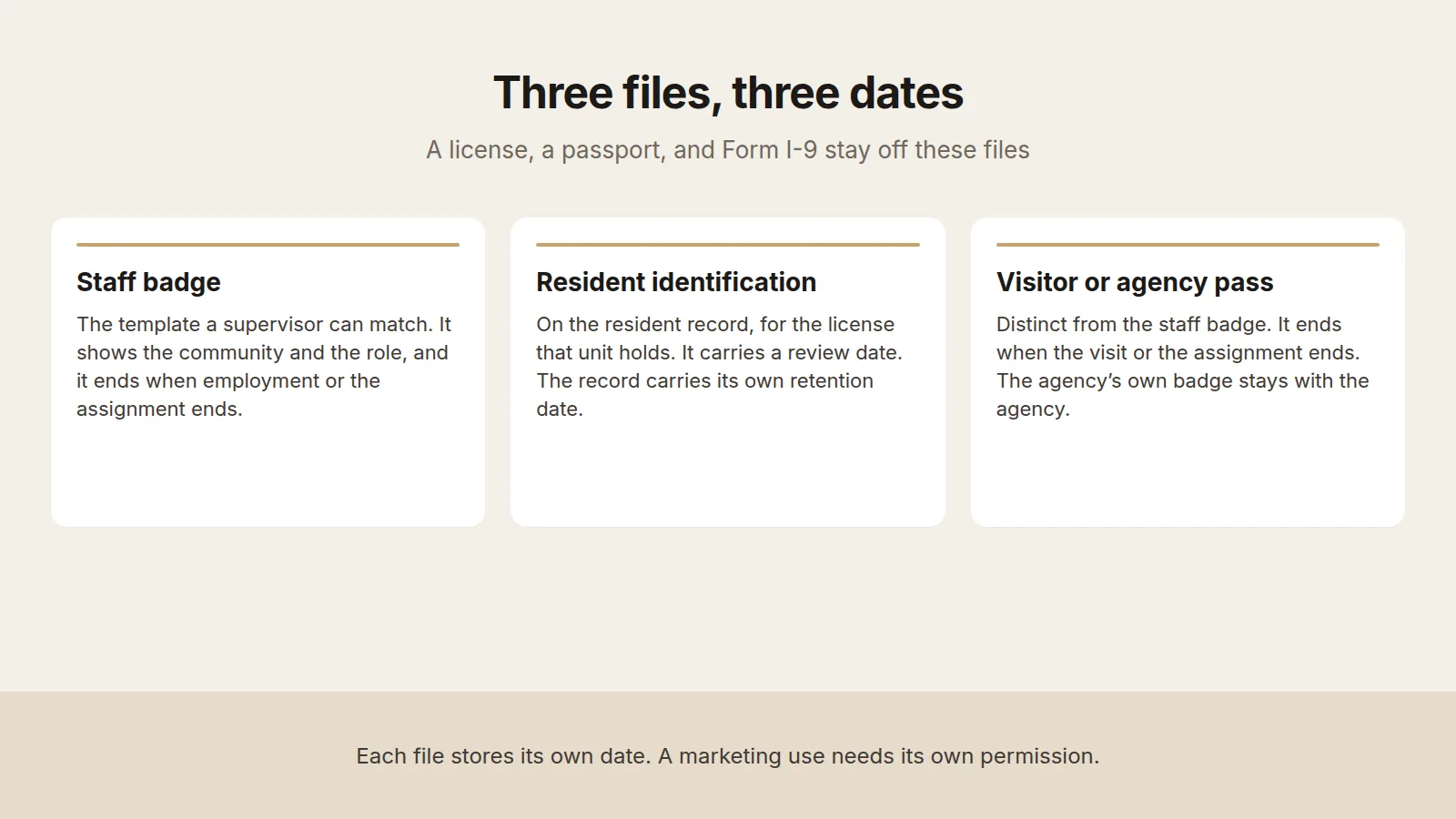
A senior living or care community keeps three photographs: one a supervisor can match on the staff badge, one on the resident record for identification, and one on the visitor or agency caregiver pass. Name the file before anyone uploads, use the camera that file allows, and store a date on every file. A badge or a pass stores an end date. A resident picture stores a review date, and the resident record stores its own retention date. A state license, a passport or visa, and Form I-9 stay on the path that owns them. A picture for the website needs its own permission.
Employed staff follow the HR badge guide. Agency caregivers follow the staffing guide. A hospital on the same health system follows the hospital guide. Contract security follows the security guide. A visa or passport file follows the immigration guide. Starting from $0.20 per photo.
What does one shared photograph cost a community?
The cost shows up as a new aide with a borrowed name tag, a missing-resident call that starts from a holiday snapshot, or a family photograph already on the website. An agency card that still opens a door after the assignment does the same thing at the next building. Independent living, assisted living, and skilled nursing on one crop are three licenses on one file.
The U.S. Bureau of Labor Statistics counted 3,489.4 thousand seasonally adjusted employees in nursing and residential care facilities (NAICS 623) in September 2026, a preliminary figure for that whole subsector. It includes nursing care and community care for the elderly, and it leaves out hospitals and home health.
| File | Who holds the camera | What goes wrong if you substitute |
|---|---|---|
| Staff badge | A link before day one, or the orientation camera. | A filtered portrait, or a resident picture reused as a badge. |
| Resident identification | The move-in camera, or a picture the resident or representative provides when the license allows it. | A marketing portrait, a badge crop, or a picture after a refusal. |
| Visitor or agency pass | That visit or assignment’s template. | Staff stock, or a door that still opens after they leave. |
| Form I-9, for people the community employs in the United States | The employee chooses the documents. A community badge is not on the Lists of Acceptable Documents. | Filing the badge as a List A or List B document, or specifying which document to bring. |
| License, passport, or visa | The board or that document’s own capture. A U.S. visa follows the Department of State. A UK passport photograph meets GOV.UK photo rules. | Sending the badge crop. The board, the embassy, or HM Passport Office decides. |
The Form I-9 instructions put Section 2 within three business days after the first day of employment, or on the first day when the job is shorter. Where the employer creates an E-Verify case, compare the photo E-Verify displays with the photo on the document presented. Agency staff complete the form with their own employer.
Which photograph rule applies to this license?
The license on the unit decides the picture. A move from assisted living to skilled nursing changes rules, and the earlier record keeps its retention clock. Independent living outside those licenses follows the community’s own policy. A nursing home covered by Medicare or Medicaid follows 42 CFR 483.10(h). CMS interpretive guidance in Appendix PP says a photograph of a resident, or of the resident’s private space, without written consent of the resident or representative, violates that right. Name identification as the purpose.
| License | What the rule requires the file to hold |
|---|---|
| Ohio nursing home | Rule 3701-17-19: a photograph for an elopement risk, updated annually. Rule 3701-17-10: assess that risk at admission. Keep the medical record seven years after discharge, longer when the resident is a minor. |
| Virginia assisted living | 22VAC40-73-560: a current picture of each resident, or an annual narrative if they refuse. Keep the record two years after they leave, the first year at the facility. |
| Georgia assisted living | Rule 111-8-63-.18: current pictures, on site, of residents at risk of eloping. You write the review date. The rule sets no number of months. |
| Arizona assisted living | R9-10-810: consent before a photograph, except an identification picture taken when the resident is accepted. |
| Maine nursing home | Title 22, section 1827: an identification photograph may be required. Every other use needs its own permission, and that permission stays out of the admission contract. |
How do communities collect these photos today?
A building that has not split the files still runs on an admission camera, a shared inbox, and one person at the printer. One move-in portrait is cropped for the badge, the newsletter, and the binder, and the folder is still full after the resident has moved.
What does a split workflow look like?
Name the file before the first link goes out. A badge or a pass stores an end date. A resident picture stores a review date. Share a crop only when both windows accept it and the purpose is the same.
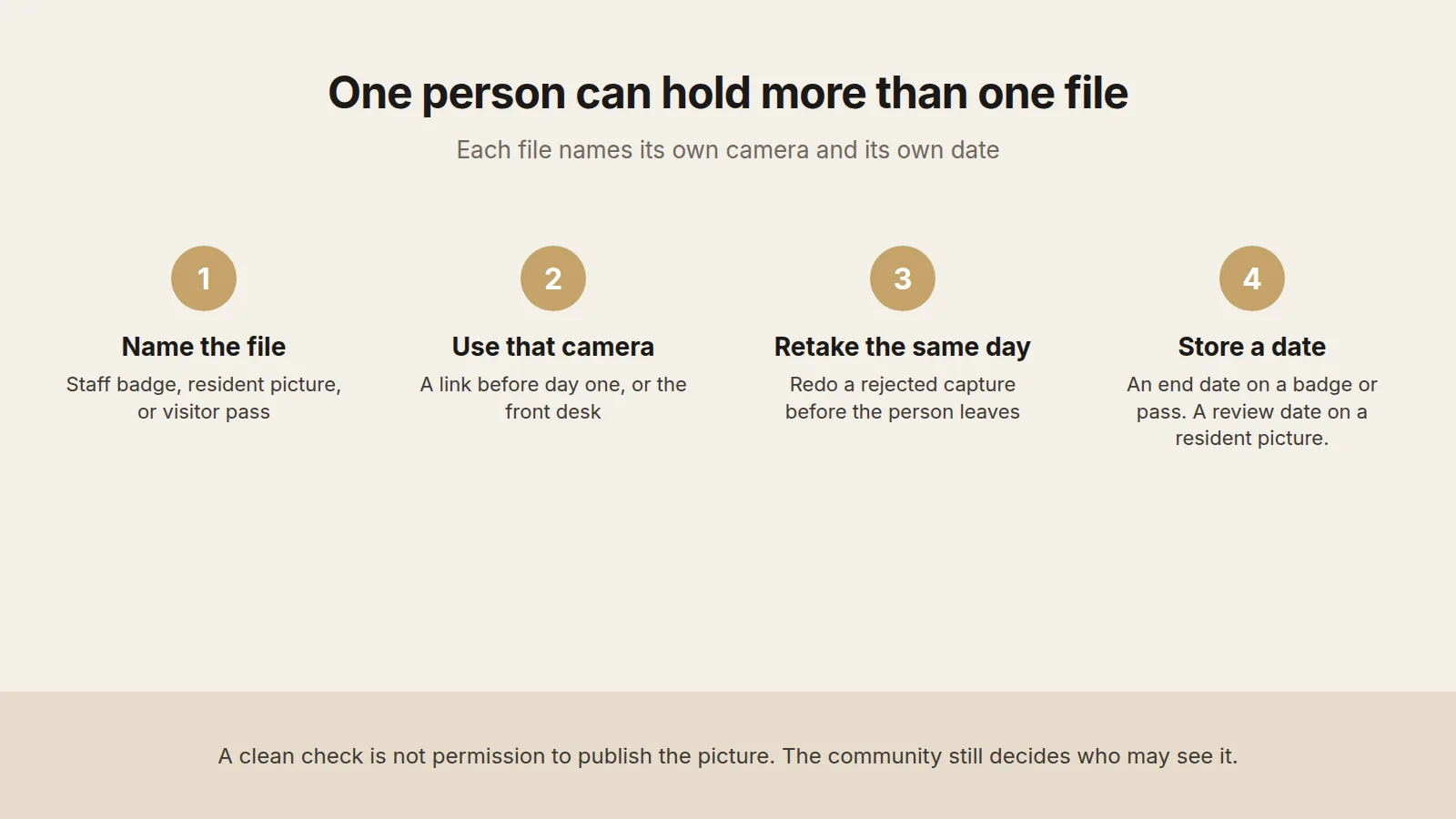
1. Write down who holds the camera. Collect a staff photograph before the first shift when you can, and the resident picture at move-in. Accept a picture the resident or representative sends only when the license allows it. Keep a camera for a retake and a walk-up. A directory portrait, including an AI headshot, stays on the directory page.
2. Sort people by the record that already owns them. A direct employee gets the staff badge and follows the HR guide. An agency caregiver gets your pass with the assignment end date, and the agency follows the staffing guide. A volunteer gets a separate template with an end date. A resident gets the identification file for that unit’s license. A visitor gets a pass that ends with the appointment. A license and a visa stay off the badge.
3. Collect the file on one link, or at the community. The badge photo service can email one link per person, with no extra account, expired after use, available per request from support@idphoto.ai. Direct-hire IDs use the employee badge page. The link does not replace consent, Form I-9, or a board application.
4. Reject a bad capture in the same visit. One person, in colour, in focus, eyes visible. The template decides clothing, glasses, and background. Background removal and photo enhancement apply only when the template allows them. A visa or UK passport photograph stays unedited. A face-mask check is available per request. See when a corrected portrait fits.
5. Write the file back with its date. The community still decides who is admitted. On a replacement, face comparison checks the new capture against the stored file. Liveness detection is available per request. Take the copy back, or use a temporary link of 2 hours to 14 days.
6. Batch one class on one template. Batch preparation returns a retake list before the print deadline. Direct hires, the agency order, and move-ins stay in separate batches.
Many printers take ID-1 stock, nominally 85.60 mm by 53.98 mm under ISO/IEC 7810. Measure that window, and any chart or visitor-pass window, before the first link.
What does the first live Monday contain?
1. Two direct-hire aides, on the staff template, with links sent the week before. Retake a failed link before the shift.
2. One agency caregiver, on the assignment template, ending on the last day of the order.
3. One move-in, on the resident template for that unit. If the resident refuses and the license allows a description, record the refusal and skip the camera.
4. One visitor pass at the desk, ending the same day, and left out of the hiring batch.
Where do these photos usually fail?
| What fails | What to change |
|---|---|
| One selfie is cropped for the badge, the resident chart, and the website | Split the files. Marketing permission names the website, the brochure, or the post. |
| The badge is filed as the Form I-9 document | The employee chooses the documents. Store the badge on the labor record. |
| A resident who refused a picture is photographed anyway | Where the rule allows a description, record the refusal. Virginia updates that description annually. |
| An agency card has no end date, or a visitor is in the hiring batch | Use the assignment template, or a visitor pass that ends with the appointment. |
| A card still opens a door after the person leaves | Deactivate it the same day. Delete the staff or visitor photograph on its date. The resident record follows its retention clock. |
| A lost staff badge is reprinted from a new selfie | Reprint from the stored file. Retake only when face comparison against that file fails. |
| The resident picture is old on the day someone is missing | Keep the review date on the file. Move it earlier when staff record a visible change. Ohio’s annual update and Georgia’s “current” picture are the latest that file may go. |
What should a community require from a vendor?
| What you need | What good looks like |
|---|---|
| A specification per picture | Size, crop, and background for each window. See the published specifications. A license and a visa sit outside this list. |
| A block on forbidden edits | A U.S. visa photograph, and a U.S. or UK passport photograph, stay unedited. See when a corrected portrait fits. |
| Rejection in the same visit | Face, light, blur, framing, and glasses, while the person is still there. A face-mask check when you ask for it. |
| A path before arrival | One link per person, no extra account, expired after use. The camera stays for a retake and a walk-up. |
| The record that owns the person | The file returns with its date. Workday or SAP SuccessFactors sync is available per request for direct employees. |
| A check a supervisor can explain | Face comparison and liveness detection are available per request. The supervisor still matches the person. |
Who may see a photograph?
The employee, the people office, and a supervisor who matches the badge may see the staff file. The resident picture is for people who need it for care and for the people the elopement procedure names. Under 45 CFR 160.103, a covered entity includes a health care provider that transmits health information electronically for a standard transaction. HHS lists full-face photographs among the identifiers removed in the de-identification safe harbor at 45 CFR 164.514. A community that is not a covered entity still follows its state picture rule. GDPR Article 5(1)(e) and the CCPA apply where those laws apply. The data privacy policy covers encrypted transmission, a temporary link of 2 hours to 14 days, or taking the image back. US and EU processing are available. Other regions are available per request.
How do you roll this out at one community?
Write the file rule before the first link. For one license type, name the templates, the windows, the end date, the review date, the retention date, and where a refusal is stored.
Run one hiring class and one move-in on those templates only. Name one owner who can decide, the same day, whether a person stays on the new path. Include one agency pass and one visitor pass. Print one badge on that printer, or confirm print and mailing with support before you promise a card in the post. Print and mailing is available per request.
Add the next level of care after a write has held. Prove a clean upload, a retake, a recorded refusal, a walk-up, and a write that fails once and is retried. A move from assisted living to skilled nursing gets the nursing-home review date, and the earlier record keeps its retention clock. Open Workday or SAP SuccessFactors only for direct employees, after support confirms the connection.
What do operations leads ask?
Does every community have to photograph every resident?
The license decides. Virginia assisted living keeps a current picture of each resident, or an annual narrative if they refuse. An Ohio nursing home keeps an annual photograph for an elopement risk. Georgia assisted living keeps current pictures of residents at risk of eloping. Independent living outside those licenses follows the community’s own policy.
Can the staff badge also be the resident identification photo?
Keep them as separate files. A badge ends with employment or the assignment. A resident picture carries a review date, and the resident record carries its own retention date. Share a crop only when both windows accept it and the purpose is the same.
Can the identification photo go on the website or in a brochure?
Only with permission that names that use. Maine requires that permission for each use other than identification, and it stays out of the admission contract. CMS interpretive guidance treats a nursing-home photograph without written consent as a violation of the privacy right.
Can a new hire send a badge photo before orientation?
Yes. One link, no extra account, expired after use, available per request from support@idphoto.ai. Keep a camera for a retake and a walk-up. Form I-9 keeps its own clock.
What if the caregiver works for an agency?
Print your pass with the assignment end date. The agency keeps Form I-9 and its own badge. The employee template stays on your direct hires.
When should the photograph be deleted?
Delete a staff or visitor file on the date stored with it. Replace a resident picture on its review date, and keep the record for the retention period in the license table above. GDPR Article 5(1)(e) keeps personal data in the UK and the EU no longer than necessary.
What does preparing the photograph cost?
It starts at $0.20 per photo. That is separate from a state license fee, a printer lease, and a government fee. The catalog covers 300+ specifications across 200+ countries.
How does idphoto.ai fit this workflow?
The idphoto.ai API is the photo step for the pictures the community keeps. It prepares a portrait to the template you name, checks the capture, and returns a file for the staff record, the resident record, or the printer. The community decides who receives a badge and who may see a resident picture. Form I-9, a state license, and a visa stay on their own path. A UK passport photograph must meet GOV.UK photo rules. A UK passport photo code retrieves a photograph that meets those rules, and HM Passport Office still decides. The catalog covers 300+ specifications across 200+ countries, starting from $0.20 per photo.
Templates, the self-service link, Workday or SAP SuccessFactors sync, print and mailing, liveness detection, a face-mask check, another processing region, and the Shopify store template with one-click setup are each available per request. The store stays off the resident record and the staff file. Email support@idphoto.ai with the card designs, which license types you hold, the review date, the retention date, and how the file returns.