
A manufacturing plant can put a photograph a turnstile can match on an employee or plant badge, on a contractor or vendor card, and on a visitor or day pass, when it keeps those three files apart. Name the file before anyone uploads, capture it before the shift or during contractor orientation, and store an end date on every credential the plant prints. A government ID, a license, and a Form I-9 portrait stay on the path that issues them.
This is the shop floor and contractor orientation. A dock, a driver, or a TWIC follows the warehouse guide. A line still under construction follows the construction guide. A utility crew on mutual aid follows the utilities guide. Direct hires follow the HR badge guide. Agency labor follows the staffing guide. Contract security follows the security guide. Starting from $0.20 per photo.
What does one shared photograph cost a manufacturing plant?
The cost shows up when the badge office is staffed on first shift only. A new operator on second or third shift waits until morning, or a supervisor uses someone else's card. A snapshot in a hard hat does not match at the turnstile. A shutdown crew waits in orientation, so the outage starts late. One crop for the badge, the contractor card, and a license puts three end dates on one file.
A warehouse gate is built around drivers. A construction fence is built around a site badge. A plant's problem is the shift the badge office misses, the orientation line, and a portrait that still has to match after PPE goes back on.
The U.S. Bureau of Labor Statistics counted 12,681 thousand seasonally adjusted manufacturing employees in October 2026, a preliminary figure. That is a payroll count, not a count of photo badges.
| File | Who holds the camera | What goes wrong if you substitute |
|---|---|---|
| Employee or plant badge | A link before the shift, including second and third shift, or the guard desk. | A night shift left on a paper list, or a card with no end date. |
| Contractor or vendor card | That work order's template, before orientation. | The vendor's own badge used as plant access, or a card that still opens after the crew leaves. |
| Visitor or day pass | Before the person is past the lobby, for that day. | Yesterday's pass still opening production, or a week on site printed as seven passes. |
| Form I-9, for people the plant employs in the United States | The employee chooses the documents. A plant badge is not on the Lists of Acceptable Documents. | Filing the badge as a List A or List B document, or specifying which document to bring. |
| License, government ID, or another program's portrait | That program's own capture. A U.S. visa follows the Department of State. A UK passport photograph meets GOV.UK photo rules. | Sending the badge crop. Each issuer still decides. |
The Handbook for Employers requires Form I-9 for someone you hire in the United States for pay. Section 2 is due within three business days, or on the first day when the job is shorter. Skip it for an independent contractor and for a staffing agency's employee. On an E-Verify case, compare the photo E-Verify displays with the document presented.
Which file owns this photograph?
No single national portrait size covers a plant credential. The plant sets the crop for the window it prints and still decides which turnstile the card opens. A license and a government ID stay on their own files. Who sits on which card is in the workflow below.
Where OSHA's process safety management standard applies, paragraph (h) covers contractors doing maintenance, repair, turnaround, major renovation, or specialty work on or next to a covered process. Janitorial work, food service, laundry, and delivery are outside it. The host controls entrance, presence, and exit. The contract employer keeps a training record: identity, date, and how understanding was checked. That record is not a portrait. A powered industrial truck certification names the operator and the dates. It is not the plant badge.
At a plant that manufactures defense articles, a visitor pass is not an export authorization. 22 CFR 120.56 treats visual inspection by a foreign person as a release of technical data. 22 CFR 120.63 defines a foreign person. Authorization stays on the export-control file. In the United Kingdom, a right-to-work check stays on its own file during employment and for two years after.
How do manufacturing plants collect these photos today?
A plant that has not split the files still runs on a first-shift badge office, a shared inbox of phone snapshots, and a contractor line at orientation. Second and third shift arrive after the clerk has gone home. A portrait taken on the line, with hearing protection on, is the one the turnstile is asked to match. Last outage's card stays active because the end date lived in a spreadsheet.
What does a split workflow look like?
Name the file before the first link goes out. Every file stores an end date. A closed badge office is not a reason to skip the photograph.
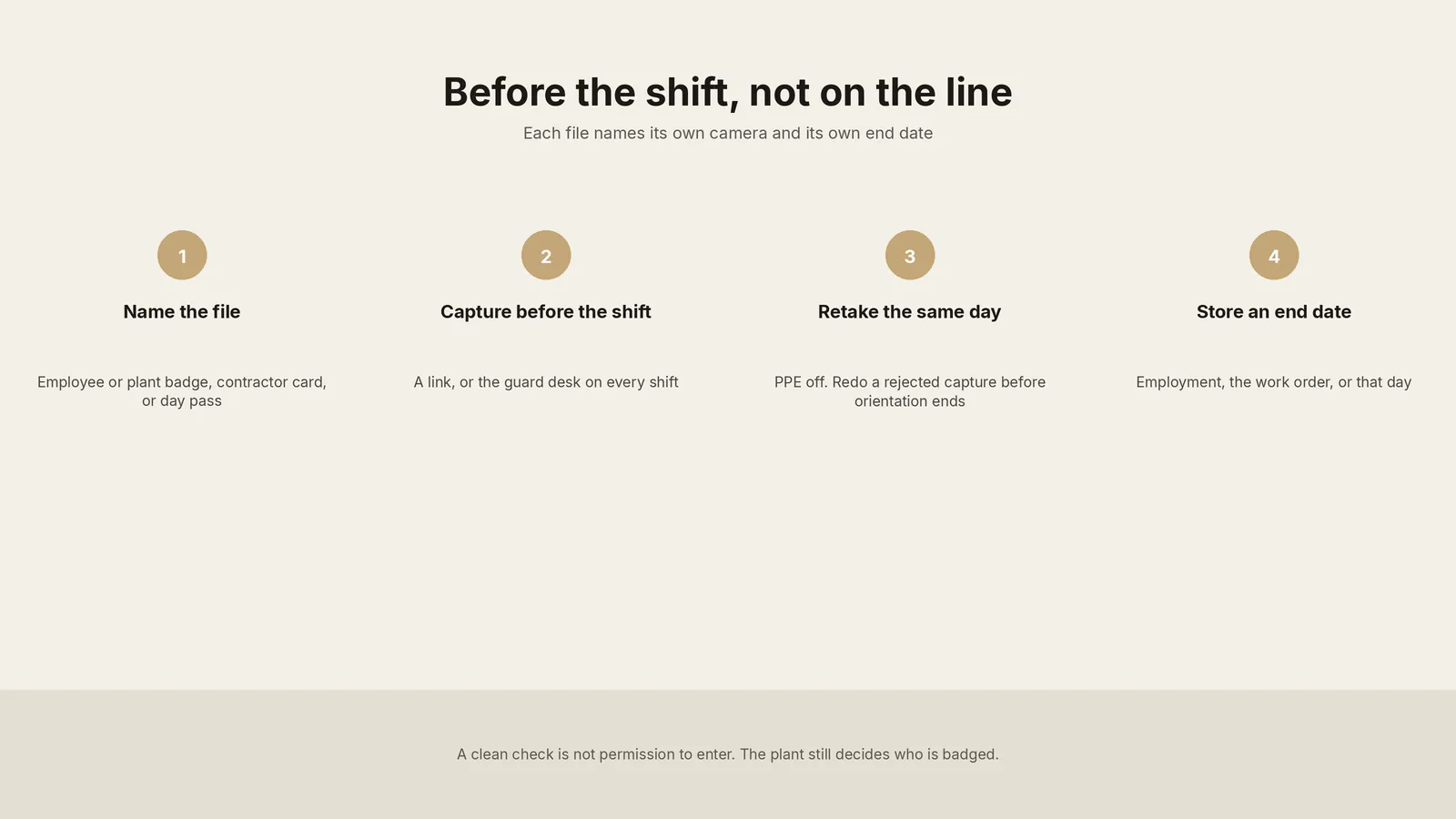
1. Write down who holds the camera. Collect the employee photo before the shift, including second and third shift, or at the guard desk. Collect the contractor photo before orientation, and the day pass before the lobby. Keep a retake camera at the guard desk on every shift. An AI headshot stays off the credential. Hard hats, safety glasses, hairnets, beard covers, and hearing protection come off for the capture, then go back on.
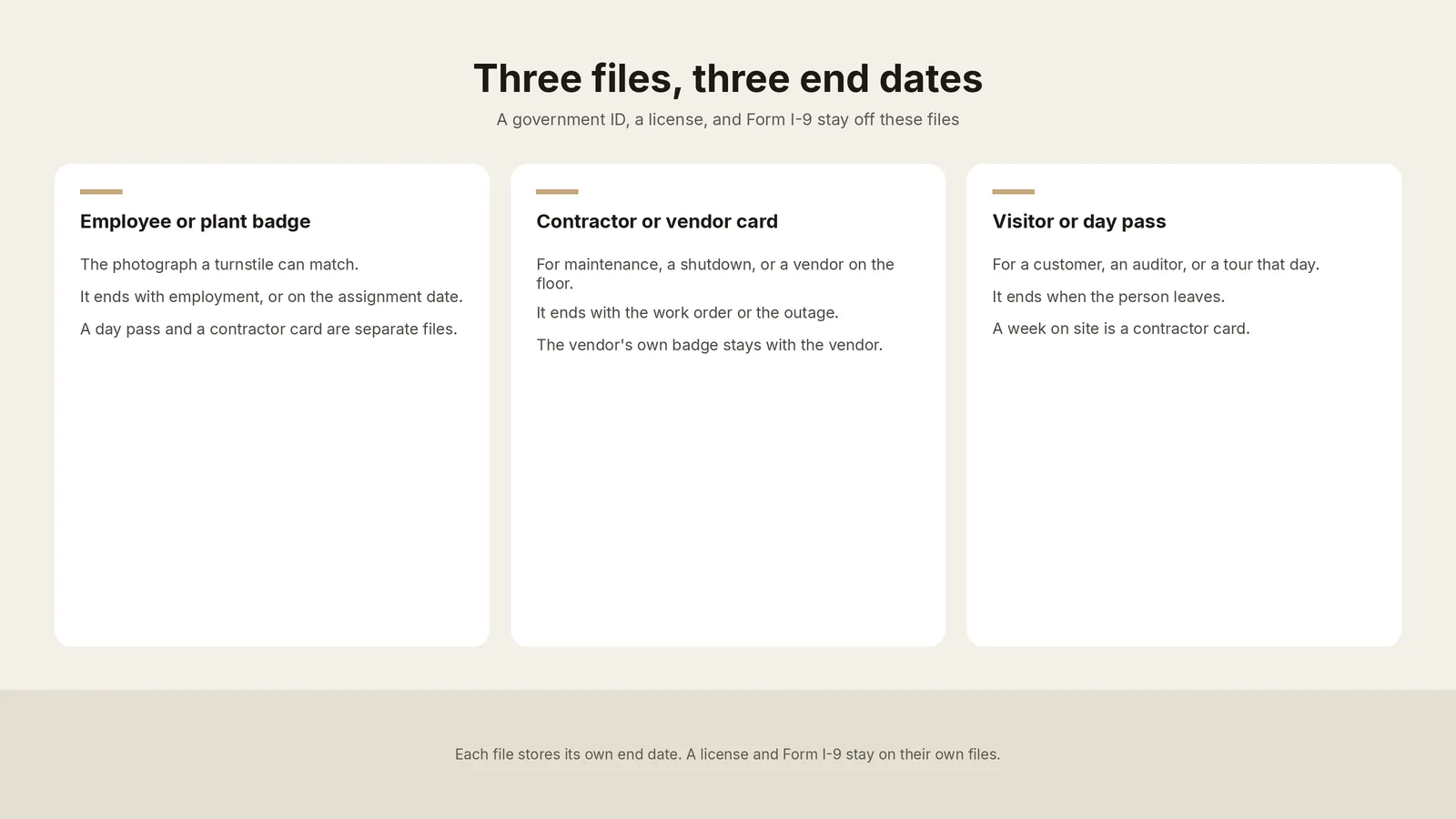
2. Sort people by the record that already owns them. The plant badge covers payroll operators, maintenance, quality, and supervisors. It ends with employment or the seasonal assignment date. One photograph covers a rotating shift, and it can feed two plants when both windows accept the crop. Each card names its plant. Agency labor follows the staffing guide.
A contractor card covers maintenance, OEM work, calibration, sanitation on the floor, and a shutdown. It ends on the work order. The vendor keeps Form I-9. A line still under construction follows the construction guide until turnover. A day pass ends when the visitor leaves. A week on site is a contractor card.
3. Collect the file on one link, or at the guard desk. The badge photo service emails one link per person, with no extra account, expired after use, available per request from support@idphoto.ai. It works without a plant email. Direct employees use the employee badge page. Keep contractor companies, that week's visitors, and restart hires in separate batches. Send the link before the shift, not from a phone on the line.
4. Reject a bad capture in the same visit. One person, in color, in focus, eyes visible. Do not shoot on the line. Background removal and photo enhancement apply only when the template allows them. A license, a visa, or a UK passport photograph stays unedited. A face-mask check is available per request.
5. Write the file back with its date. The plant decides who enters and which turnstile the card opens. On a replacement, face comparison checks the new capture against the stored file. Liveness detection is available per request. Take the copy back, or use a temporary link of 2 hours to 14 days. Deactivate the card on its date.
6. Batch one class on one template. Batch preparation returns a retake list before the print deadline. Change the color from the previous shutdown so last outage's card is obvious at the turnstile.
Many printers take ID-1 stock, 85.60 mm by 53.98 mm under ISO/IEC 7810. Measure the window before the first link.
What should plant security, EHS, and people operations require from a photo service?
| What you need | What good looks like |
|---|---|
| A specification per picture | Size, crop, and background for each window. See the spec code reference. A license and a visa sit outside it. |
| A block on forbidden edits | A license, a visa, and a U.S. or UK passport photograph stay unedited. |
| Rejection in the same visit | Face, light, blur, and framing at orientation or the guard desk, with PPE off. Not a retake on the next first shift. |
| A path before the shift | One link per person, no extra account, expired after use, including a contractor without a plant email. A camera at the guard desk every shift. |
| The record that owns the person | The file returns with its end date, the plant, and the areas. Workday or SAP SuccessFactors sync is available per request for employees. |
| A check a turnstile can explain | Face comparison and liveness detection are available per request. The plant still decides who may enter. |
How do you roll this out across shifts and plants?
Write the file rule before the first link. Name the templates, the windows, the end dates, and which cards open production, chemical storage, the lab, the tool crib, the dock, and the office. Name which shifts the guard-desk camera covers. A guest for the day is a day pass. Approval at one plant does not open the next.
Run one plant for one week on those templates only. Pick a quiet week, not a shutdown, a turnaround, or a new-line startup. Use two employee badges, including one second-shift or third-shift hire, one contractor card that ends when that crew leaves, and one day pass that ends that day. Print one card, or confirm print and mailing before you promise a card in the post. Print and mailing is available per request.
Add the next shift after a write has held. Prove a clean upload, a retake, a walk-up while the badge office is closed, and one failed write that is retried. Then add the next plant. Open Workday or SAP SuccessFactors only for employees, after support confirms it.
Where do these photos usually fail?
| What fails | What to change |
|---|---|
| Third shift waits for the badge office, or someone else's card is used | Send the link before the shift. Keep a camera at the guard desk on every shift. |
| The portrait shows a hard hat, glasses, a hairnet, or hearing protection | Retake with PPE off, then put it back on. Do not shoot on the line. |
| A shutdown card or a day pass still opens a turnstile the next day | Deactivate the card on its date. The next outage is a new card. A week on site is a contractor card. |
| Plant A's card is treated as access at plant B | Each card names the plant, the areas, and the end date. One photograph can still feed both windows. |
| A vendor badge, a construction badge, or a driver pass opens production | Print the card you issue. End site badges at turnover. The dock follows the warehouse guide. |
Who may see a photograph?
The person, the people lead, a supervisor, and the turnstile may see the file they need. EHS sees the orientation roster, not the personnel file. Keep the credential photograph off a social account unless permission names that use. GDPR Article 5(1)(e) and the CCPA apply where those laws apply. The data privacy policy covers encrypted transmission, a temporary link of 2 hours to 14 days, or taking the image back. US and EU processing are available. Other regions are available per request. The badge file ends on the stored date. Form I-9 keeps its own clock.
What do plant security and people leads ask?
Does every operator, contractor, and visitor need a photo on the credential?
The rule you operate under decides. Where you print a photograph, it matches a face to that record. Measure the window.
Can a visitor day pass also be the plant badge?
Keep them separate. The day pass ends when the person leaves. Print the plant badge when the person is hired.
Can a shutdown contractor keep the card for the next outage?
No. It ends on the last day of that outage. The next outage is a new card. The training record, where required, stays on the safety file.
Can a contractor company send one set of photos for the whole crew?
Each person needs a file. The vendor keeps Form I-9 when the vendor is the employer. You print the card, with that work order's end date.
Can a new hire on second or third shift send a photo before the shift?
Yes. One link, no extra account, expired after use, available per request from support@idphoto.ai. Keep a camera at the guard desk on every shift.
What if the person works at two plants?
Keep one photograph when both windows accept the crop. Each card names the plant, the areas, and the end date.
Can a license, a government ID, or a Form I-9 portrait be the badge?
No. Those stay on the file that issued them. The badge crop stays on the credential you print.
Does process safety management require a photograph on the contractor card?
No. Paragraph (h) requires a training record for named contractor work on a covered process. It does not set a portrait size.
When should the photograph be deleted?
Delete the badge file on the stored date and deactivate the card then. Form I-9 is kept for three years after hire, or one year after employment ends, whichever is later.
What does preparing the photograph cost?
It starts at $0.20 per photo, separate from a printer, a background check, and a government fee. The catalog covers 300+ specifications across 200+ countries.
How does idphoto.ai fit this workflow?
The idphoto.ai API is the photo step. It prepares a portrait to the template you name, checks the capture, and returns a file for the employee record, the contractor record, the day-pass record, or the printer. The plant decides who receives a card and which turnstile it opens. Form I-9, a license, a government ID, a training record, and a visa stay on their own path. A UK passport photo code retrieves a photograph that meets GOV.UK photo rules, and HM Passport Office still decides. Preparing a photo starts at $0.20, from a catalog of 300+ specifications across 200+ countries.
Templates, the self-service link, Workday or SAP SuccessFactors sync, print and mailing, liveness detection, a face-mask check, another processing region, and the Shopify store template with one-click setup are each available per request. The store template stays off the access record. Email support@idphoto.ai with the card designs, which passes open production and which end that day, the shifts the guard desk covers, and how the file returns. Request samples stay in the API docs.