

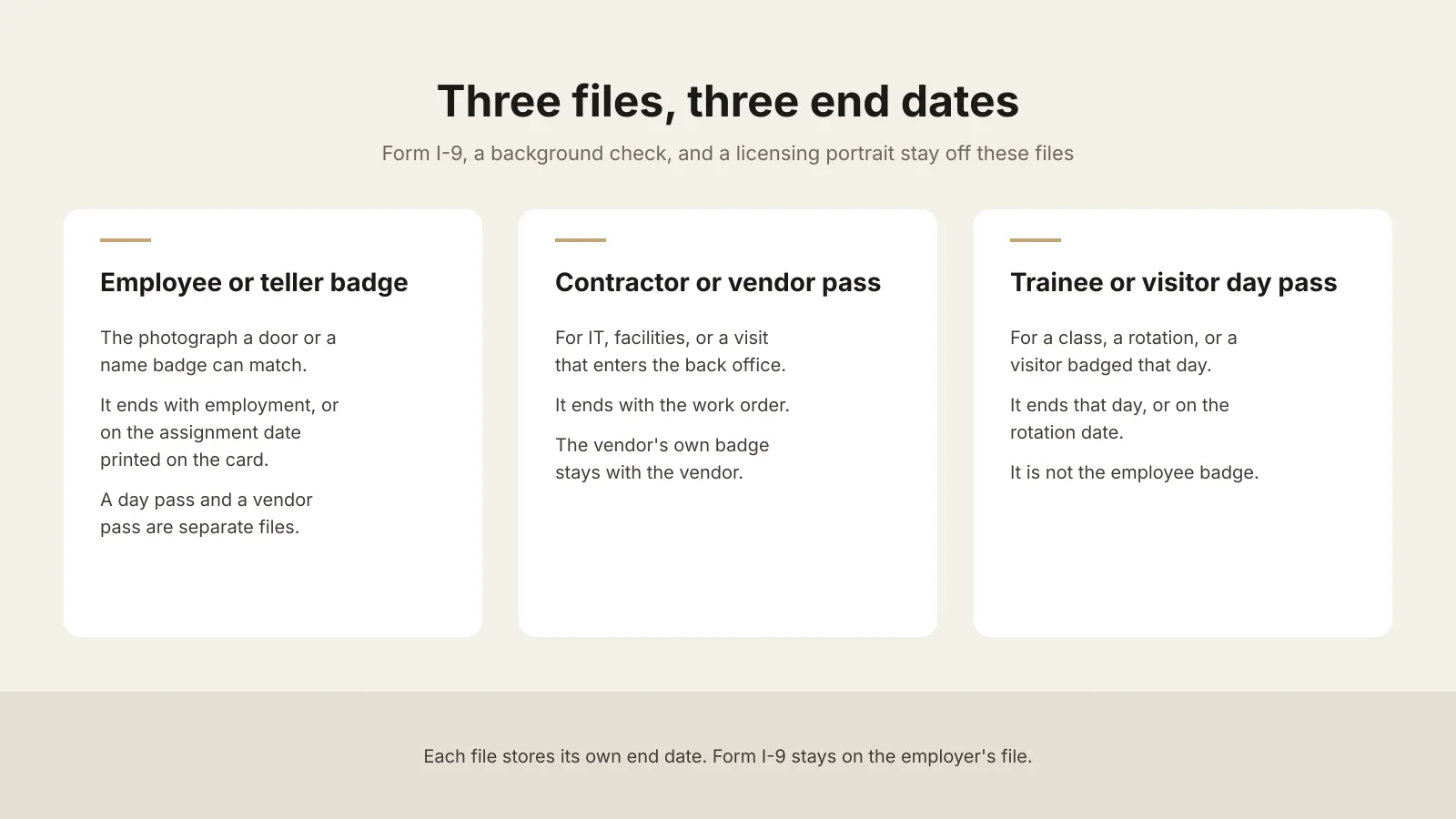
A bank or a credit union can put a photograph a door or a name badge can match on an employee or teller badge, on a contractor or vendor pass, and on a temporary, trainee, or visitor day pass, when it keeps those three files apart. Name the file before anyone uploads, capture it without a trip to headquarters, and store an end date on every credential a branch prints. Form I-9, a background-check packet, and a regulator or licensing portrait stay on the path that issues them.
Direct hires follow the HR badge guide. Seasonal or branch labor hired through an agency follows the staffing guide. Contract security at a branch follows the security guide. A branch build or remodel follows the construction guide. Starting from $0.20 per photo.
What does one shared photograph cost a bank or credit union?
The cost shows up at a branch opening. New tellers wait for the headquarters photographer, so the soft open runs on paper name tags a door camera cannot match. An IT technician arrives with a dark selfie, and the core cutover waits. One crop used for the teller badge, the vendor pass, and a licensing portrait puts three end dates on one file.
The U.S. Bureau of Labor Statistics counted 1,346.2 thousand seasonally adjusted employees in commercial banking (NAICS 52211) in October 2026, a preliminary figure. The credit-union series (NAICS 52213) showed 326.2 thousand in September 2026, also preliminary. October was not yet on that series. Those counts are separate from each other and from a count of photo badges.
| File | Who holds the camera | What goes wrong if you substitute |
|---|---|---|
| Employee or teller badge | A link before day one, or the branch security desk on arrival. | A day pass left active after the person is placed, or a tax-season card still opening a door in July. |
| Contractor or vendor pass | That work order's template, before the technician, the facilities crew, or the back-office visit. | The vendor's company badge used as branch access, or a pass with no end date. |
| Trainee or visitor day pass | Before the class, the rotation, or the visitor is past the lobby. | Yesterday's pass still opens the employee entrance, or a visitor using an employee badge. |
| Form I-9, for people the institution employs in the United States | The employee chooses the documents. A branch card is not on the Lists of Acceptable Documents. | Filing the card as a List A or List B document, or specifying which document to bring. |
| Background check, or a regulator or licensing portrait | The screener's packet, or the filing that asked for the portrait. A U.S. visa follows the Department of State. A UK passport photograph meets GOV.UK photo rules. | Sending the badge crop to the screener, the regulator, or the embassy. Each issuer still decides. |
The Handbook for Employers requires Form I-9 for a person you hire in the United States for wages or other remuneration. Section 2 is due within three business days of the hire, and on the first day when the job is shorter than that. Skip it for an independent contractor and for a staffing agency's employee. On an E-Verify case, compare the photo E-Verify displays with the document presented.
Which file owns this photograph?
No single national portrait size covers a branch credential. The institution sets the crop for the window it prints and still decides which door the card opens. A background check and a licensing portrait stay on their own files.
A tax-season teller on your payroll uses the employee file, and the card ends on the assignment date. Next season is a new card. Section 8 of the handbook may treat that return as continuing employment. The card is still new. When a staffing agency employs the worker, the agency completes Form I-9 and you print the card. In the United Kingdom, a right-to-work check stays on its own file, kept during employment and for two years after. Contract security follows the security guide. An SIA photocard stays with the licence holder.
How do banks and credit unions collect these photos today?
An institution that has not split the files still runs on a shared inbox and a quarterly photo day at headquarters. A branch borrows a phone in the lobby. A vendor's company badge is waved through the employee entrance. A new city's tellers are photographed weeks after the doors open, because the photographer's route skipped them.
What does a split workflow look like?
Name the file before the first link goes out. Every file stores an end date. Headquarters is not on the capture path.
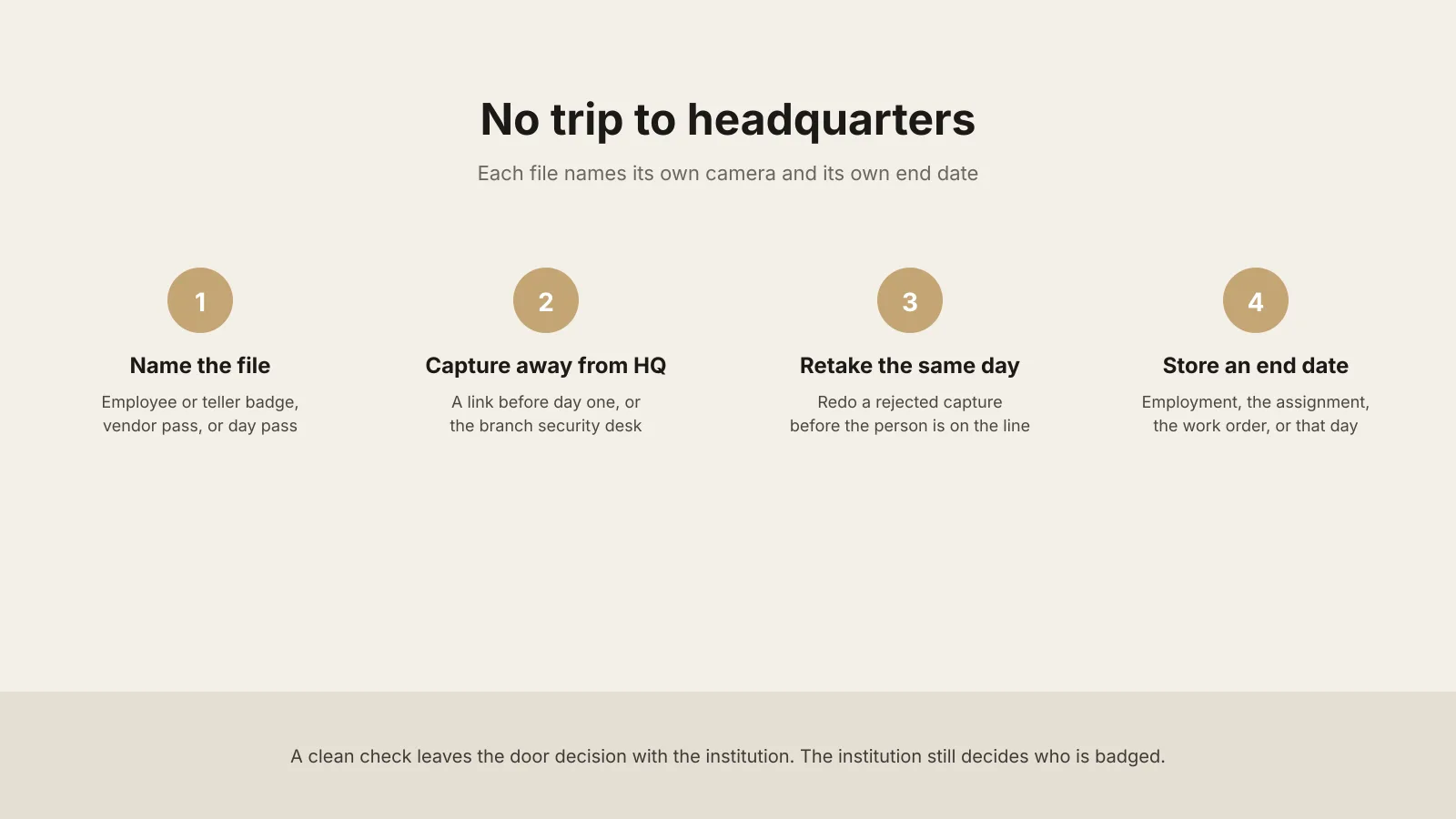
1. Write down who holds the camera. Collect the employee photo on a link before day one, or at the branch security desk on arrival. Collect the vendor photo before the work window. Collect the day pass before the person is past the lobby. Keep a retake camera at the branch. An AI headshot stays on a public page, off the credential.
2. Sort people by the record that already owns them. An employee or teller badge ends with employment, or on the assignment date. A tax-season hire on your payroll uses this file, and next season is a new card. One person at two branches has one photograph. The card names the branches and the end date. A name badge and a door card can be two prints of this file.
A vendor pass covers IT, facilities, an ATM visit, an armored-carrier employee who enters the back office, or a remodel crew. The vendor keeps Form I-9. You print the pass, ending on the work order. A branch build follows the construction guide. A class, a trainee rotation, and a visitor badged for the day each get a day pass that ends that day or on the rotation date. Print the employee badge when the trainee is placed. A regulator's own credential stays with the regulator.
3. Collect the file on one link, or at the branch desk. The badge photo service emails one link per person, with no extra account, expired after use, available per request from support@idphoto.ai. Direct employees use the employee badge page. A branch opening in another city is one batch: the teller class gets the link the week before the soft open, the facilities crew ends on the last install day, and visitors who are not on the payroll get a day pass that ends that evening.
4. Reject a bad capture in the same visit. One person, in color, in focus, eyes visible. Hats and sunglasses come off. A name badge already clipped to the shirt comes off for the capture, then goes back on. Background removal and photo enhancement apply only when the template allows them. A licensing portrait, a visa, or a UK passport photograph stays unedited. See when a corrected portrait fits.
5. Write the file back with its date. The institution still decides who may enter and which door the card opens. On a replacement, face comparison checks the new capture against the stored file. Liveness detection is available per request. Take the copy back, or use a temporary link of 2 hours to 14 days. Deactivate the card on its date, even when payroll closes a day later.
6. Batch one class on one template. Batch preparation returns a retake list before the print deadline. Keep one branch opening, one tax-season class, and one vendor company in separate batches. Change the color or the layout from the previous season, so last year's card is obvious at the employee entrance.
Many printers take ID-1 stock, 85.60 mm by 53.98 mm under ISO/IEC 7810. Measure the window before the first link.
What should security and people ops require from a photo service?
| What you need | What good looks like |
|---|---|
| A specification per picture | Size, crop, and background for each window. See the spec code reference. A licence, a background-check portrait, and a visa sit outside this list. |
| A block on forbidden edits | A licensing portrait, a visa photograph, and a U.S. or UK passport photograph stay unedited. |
| Rejection in the same visit | Face, light, blur, and framing while the person is still at the branch desk, not on a later trip to headquarters. |
| A path before day one | One link per person, no extra account, expired after use. Keep a camera at the branch security desk for a retake. |
| The record that owns the person | The file returns with its end date, and with the branches the card opens. Workday or SAP SuccessFactors sync is available per request for employees. |
| A check a door can explain | Face comparison and liveness detection are available per request. The institution still decides who may enter. |
How do you roll this out across branches?
Write the file rule before the first link. Name the templates, the windows, the end dates, and which cards open the employee entrance, the teller line, the vault, and the cash room. Name which cards are valid at a second branch. A guest badged only for the day is a day pass, not an employee badge.
Run one branch for one week on those templates only. Pick a quiet week before a tax-season class or a soft open. Use two employee badges with an end date, one vendor pass that ends when the crew leaves, and one day pass that ends that day. Print one card, or confirm print and mailing before you promise a card in the post. Print and mailing is available per request.
Add the next region after a write has held. Prove a clean upload, a retake, a walk-up at the branch desk, and one failed write that is retried. Open Workday or SAP SuccessFactors only for employees, after support confirms it. A branch opening is its own batch after that. Leave the headquarters photographer off the path.
Where do these photos usually fail?
| What fails | What to change |
|---|---|
| A day pass still opens a door the next morning | Deactivate it that day. Print the employee badge only when a trainee is placed. |
| A tax-season card still opens a door in July | Deactivate it on the assignment date. Next season is a new card. |
| A transfer branch shoots again | Keep one photograph. The card names the branches and the end date. |
| A vendor's company badge is treated as branch access | Print the pass you issue, with the work order's end date. |
| A lost badge is reprinted from a lobby selfie | Reprint from the stored file. Retake only when face comparison fails. |
| Capture happens on the teller line during open hours | Use a link before the shift, or the branch security desk. |
| A licensing portrait is filed as the badge | Keep the filing and the credential on separate files. |
| Last season's color is printed again | Change the design. Keep the credential image off social accounts. |
Who may see a photograph?
The person, the branch people lead, a supervisor, and the door may see the file they need. Members and customers see the name badge on the line. Keep the credential photograph off a social account. GDPR Article 5(1)(e) and the CCPA apply where those laws apply. The data privacy policy covers encrypted transmission, a temporary link of 2 hours to 14 days, or taking the image back. US and EU processing are available. Other regions are available per request. The badge file ends on the stored date. Form I-9 keeps its own clock.
What do branch security and people leads ask?
Does every teller, vendor, and visitor need a photo on the credential?
The rule you operate under decides. Where you print a photograph, it matches a face to that record. Measure the window on the card.
Can a trainee day pass also be the employee badge?
Keep them separate. The day pass ends that day or on the rotation date. Print the employee badge when the trainee is placed.
Can a tax-season teller keep last year's card?
No. The employee file ends on the assignment date. Next season is a new card. Section 8 decides whether Form I-9 can be reused.
Can an IT vendor or a facilities company send one set of photos for the whole company?
Each person needs their own file. The vendor keeps Form I-9 when the vendor is the employer. You print the pass you issue, with that work order's end date.
Can a new hire send a photo before the first day at the branch?
Yes. One link, no extra account, expired after use, available per request from support@idphoto.ai. Keep a retake camera at the branch security desk. A job shorter than three business days completes Section 2 on the first day.
What if the person works at two branches, or transfers?
Keep one photograph on the person's record. The card names the branches and the end date. A transfer moves with the HR record.
Can a background-check photo or a licensing portrait be the badge?
A background-check packet stays with the screening file. A portrait a regulator or a licensing system asks for stays on that filing. The badge crop stays on the credential you print.
When should the photograph be deleted?
Delete the badge file on the stored date, and deactivate the card then. Form I-9 is kept for three years after hire, or one year after employment ends, whichever is later. A UK right-to-work copy is kept during employment and for two years after the person stops.
What does preparing the photograph cost?
It starts at $0.20 per photo. That is separate from a printer lease, a background check, and a government fee. The catalog covers 300+ specifications across 200+ countries.
How does idphoto.ai fit this workflow?
The idphoto.ai API is the photo step. It prepares a portrait to the template you name, checks the capture, and returns a file for the employee record, the vendor record, the day-pass record, or the printer. The institution decides who receives a card and which door it opens. Form I-9, a background-check packet, a licensing portrait, a right-to-work check, an SIA licence, and a visa stay on their own path. A UK passport photo code retrieves a photograph that meets GOV.UK photo rules, and HM Passport Office still decides. Preparing a photo starts at $0.20, from a catalog of 300+ specifications across 200+ countries.
Templates, the self-service link, Workday or SAP SuccessFactors sync, print and mailing, liveness detection, another processing region, and the Shopify store template with one-click setup are each available per request. The store template stays off the access record. Email support@idphoto.ai with the card designs, which passes open the vault and the employee entrance, the end dates, and how the file returns. Request samples stay in the API docs.